

You have chosen your thesis topic. You have identified the problem you want to investigate, and you are ready to start planning your study.
But there is one important question you need to answer before moving forward:
What exactly do you want your research to find out?
This is where research questions come in.
Your research topic tells people what your study is about. Your research problem explains what needs to be investigated. Your research questions take things a step further by identifying the specific things your study intends to answer.
However, developing good research questions is not always straightforward.
You might have several questions about your topic but struggle to decide which ones are relevant. Perhaps your questions are too broad, or you are unsure whether they can actually be answered through research.
In this guide, we will explain how to develop clear and focused research questions, what makes a good research question, and how to use Thesis SpeedWrite to get started.
What Are Research Questions?
Research questions are specific questions that a study seeks to answer.
They help define what you want to investigate and provide direction for the entire research process.
For example, consider this thesis topic:
The Relationship Between Social Media Use and Academic Performance Among Undergraduate Students.
A possible research question is:
“Is there a relationship between social media use and academic performance among undergraduate students?”
This question identifies something specific the researcher wants to investigate.
Rather than simply discussing social media and academic performance generally, the researcher now has a clearer direction for the study.
Research questions also help connect the different parts of your thesis. They guide your research objectives, influence your choice of methodology and help you determine what information you need to collect and analyse.
Without clear research questions, your study can easily become too broad or lose focus.
1. Start With Your Research Problem
Before developing your research questions, you need to understand the problem your study intends to address.
Your questions should emerge from the issue you want to investigate, not simply from the words in your thesis title.
For example:
Research topic: Employee motivation in the workplace.
Research problem: The researcher wants to understand how flexible working arrangements relate to employee job satisfaction.
From this problem, you could develop the following research question:
“How are flexible working arrangements related to job satisfaction among employees in the selected organisation?”
The question gives the researcher a specific issue to investigate.
If you are still struggling to explain the issue your study addresses, revisit your research problem before proceeding.
Your questions will be much easier to formulate when you understand what you are trying to find out.
2. Understand the Type of Research Question You Need
Not all research questions serve the same purpose. The type you develop should depend on what you want your study to accomplish.
Here are three common types to consider.
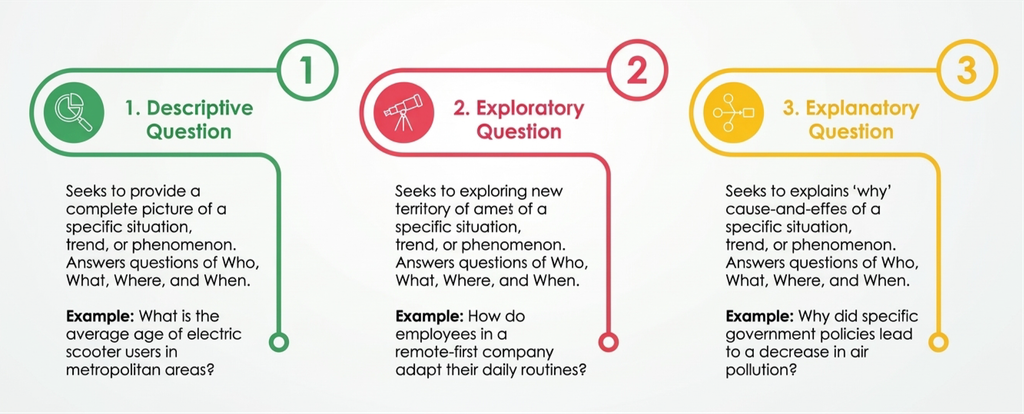
Descriptive research questions
These questions seek to describe a situation, characteristic or pattern.
For example: “What study strategies do final-year undergraduate students use when preparing for examinations?”
The question focuses on identifying and describing what is happening. Descriptive questions are useful when your research aims to understand the characteristics of a particular group, situation or phenomenon.
Exploratory research questions
These questions seek to understand experiences, perceptions or issues that require further investigation.
For example: “How do undergraduate students describe their experiences of social media distraction during independent study?”
This question allows the researcher to explore how participants experience and understand a particular issue. Exploratory questions are particularly useful when you want to gain deeper insights into a phenomenon.
Explanatory or relationship-focused research questions
These questions investigate relationships between concepts or seek to understand why or how something occurs.
For example: “Is there an association between social media use and academic performance among undergraduate students?”
This question focuses on examining a possible relationship between two variables. Remember that identifying an association does not automatically establish that one variable causes the other. Your research design determines the conclusions you can draw.
Understanding these different question types can help you choose a direction that fits your research problem and intended methodology.
3. Make Your Research Questions Specific and Focused
One common mistake is developing questions that are too broad to guide a manageable study.
Consider this question: “How does social media affect students?”
It sounds reasonable, but it leaves too much unanswered.
Which students? What aspect of social media? What does “affect” mean? Are you interested in academic performance, concentration, study habits or social behaviour?
A more focused question might be:
“How do final-year undergraduate students describe the influence of social media notifications on their concentration during independent study?”
The revised question identifies a specific group, experience and context. A different researcher might investigate the relationship between daily social media usage and academic performance. Both directions are possible, but they would require different research approaches.
A useful tip: When reviewing your questions, check whether you can clearly identify what you want to investigate, who or what the study focuses on and what context is relevant.
You do not need to include every detail in every question. The goal is to remove unnecessary ambiguity and establish a clear research direction.

4. Ensure Your Research Questions Can Be Answered
A research question should be more than an interesting question. It should be something you can investigate using appropriate evidence.
For example: “Why are students becoming less interested in education?”
This question contains a broad assumption and does not clearly define which students, what declining interest means or how the issue could be investigated.
A more researchable version might be: “What factors do undergraduate students identify as influencing their engagement with online learning?”
This version gives the researcher a clearer population and a specific issue to investigate. Before settling on your questions, consider the following:
- Can I identify the information needed to answer this question?
- Is there an appropriate research method for investigating it?
- Can I access the relevant data, documents or participants?
- Can I answer it within the time and resources available?
- Does it directly address my research problem?
A question may sound academically impressive but still be unsuitable if you cannot realistically investigate it. Think about the evidence you will need before committing to the questions.
5. Align Your Research Questions With Your Research Objectives
Your research questions and objectives should work together. However, they serve different purposes.
A research question asks what the study seeks to find out.
A research objective describes what the researcher intends to accomplish.
For example:
Research question:
“What factors influence undergraduate students’ use of social media during independent study?”
Corresponding research objective:
“To examine the factors influencing undergraduate students’ use of social media during independent study.”
Notice the difference?
The question identifies what you want to find out, while the objective describes the action you intend to take. If your research questions and objectives do not align, your thesis may become difficult to organise.
For instance, you might have an objective focused on examining students’ study habits but a research question that focuses entirely on their social relationships. Although both relate to social media, they may not serve the same research purpose. Review each question alongside its corresponding objective to ensure that they address the same issue.
6. Avoid Developing Too Many Research Questions
When you are interested in a subject, it can be tempting to investigate every possible issue connected to it. However, having more research questions does not automatically make your thesis stronger. Too many questions can expand your scope, introduce unrelated issues and make it difficult to organise your research.
Instead, focus on the questions that are necessary to address your research problem. The appropriate number depends on your research design, academic level and departmental requirements.
For each question, ask:
- Does this question contribute to the main purpose of my study?
- Is it different from the other questions?
- Can I realistically investigate it?
- Does it help address my research problem?
If a question does not contribute meaningfully to your study, consider removing or revising it. Your aim is to develop a coherent set of questions, not the longest possible list.
How Thesis SpeedWrite Helps You Develop Research Questions
By this stage, you may understand your thesis topic and the problem you want to investigate, but still find it difficult to formulate the questions that will guide your study.
This is where Thesis SpeedWrite can help you get started.
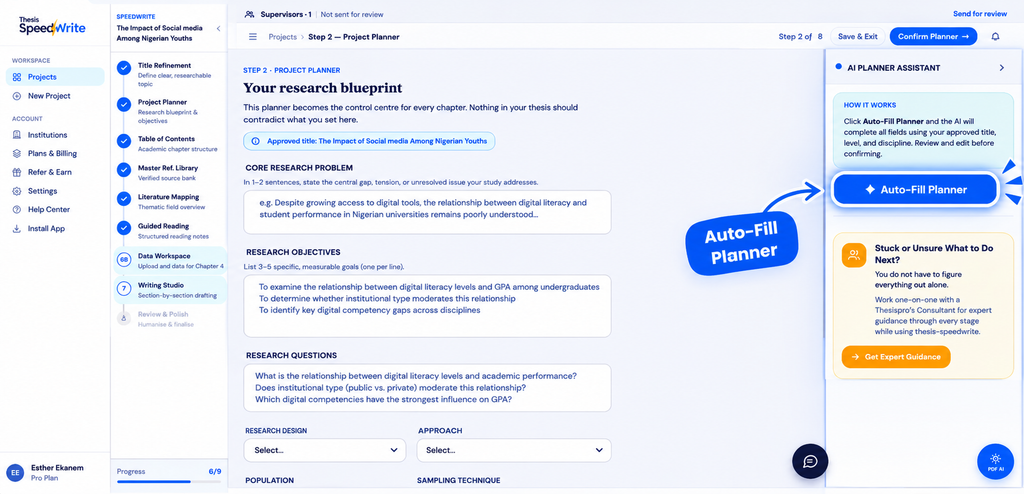
Once your thesis topic is in the system, you can use the AI autofill feature to populate the research-question inputs for you. Instead of staring at empty fields and trying to figure out what to write, you have an initial set of questions to work through.
Here’s how it works.
Step 1: Get Your Thesis Topic Into Thesis SpeedWrite
Start by entering your thesis topic into the system.
Your topic provides the context for the research-planning process, giving the system a starting point for the subsequent inputs.
Step 2: Use AI Autofill to Populate Your Research-Question Inputs
When you get to the research-question section, use the AI autofill feature. Thesis SpeedWrite populates the relevant inputs with suggested research questions based on your research topic. This helps you get past the initial difficulty of figuring out what to write and gives you something to review and work with.
Step 3: Review and Refine the Questions
AI-generated questions should be treated as a starting point, not as final research decisions. Read through the suggestions and consider whether they reflect what you actually want to investigate.
Ask yourself:
- Do these questions address my research problem?
- Are they specific enough?
- Can I answer them using appropriate evidence?
- Do they fit the scope of my thesis?
If a question does not reflect your intended research direction, make the necessary adjustments. Remember, you are still responsible for ensuring that your research questions are academically appropriate and aligned with your study.
Step 4: Continue Developing Your Research
Once you have reviewed your questions, you can continue working through the other parts of your research plan. Consider how your research questions connect to your objectives, methodology and the evidence you will need. This helps you move from having a thesis topic to developing a more organised research direction.
With Thesis SpeedWrite, you don’t have to approach every planning input from a blank page. Its AI autofill feature gives you a starting point so you can spend more time reviewing, refining and making informed research decisions.
What Comes After Developing Your Research Questions?
Developing your research questions is an important milestone, but there are other decisions to make before you begin writing your thesis.
Your next steps include:
- Finalising your research objectives: Ensure that your objectives clearly describe what you intend to accomplish in answering your research questions.
- Developing your methodology: Decide how you will collect and analyse the evidence needed to answer your questions.
- Reviewing relevant literature: Examine existing research to strengthen your understanding of the subject and support your research direction.
- Discussing your research plan with your supervisor: Get feedback to identify areas that may need clarification or further development.
These steps help ensure that your research questions do not exist in isolation but form part of a coherent research project.
Final Thoughts
Good research questions give your thesis direction.
They help you move beyond a general topic, define what you want to investigate and establish a clearer connection between your research problem, objectives and methodology.
Start with the problem you want to address. Identify what you need to understand, make your questions specific and ensure they can be investigated using appropriate evidence.
And remember, your first set of research questions does not have to be perfect. Research often involves reviewing and refining your ideas as you learn more about your subject.
If you already have your thesis topic but need help getting started with your research questions, Thesis SpeedWrite’s AI autofill feature can populate the relevant inputs for you to review and develop further.
Ready to organise your research direction? Explore Thesis SpeedWrite and start working through your research-planning inputs.