You have read several journal articles, taken notes and perhaps even written summaries of previous studies. But when you put everything together, your literature review still feels like a list of what different researchers have done.
One study discusses one finding, another presents a different result. You have explained both, but you are unsure how to connect them or what they collectively tell you about your research topic. This is where literature synthesis becomes important.
A strong literature review does more than report previous research. It brings existing studies together, examines their findings and shows how they relate to the problem you are investigating.
In this guide, you will learn how to synthesise academic literature, compare previous studies and identify research gaps that can help establish the need for your thesis.
How to Synthesise Literature and Identify Research Gaps
1. Understand the Difference Between Summarising and Synthesising Literature
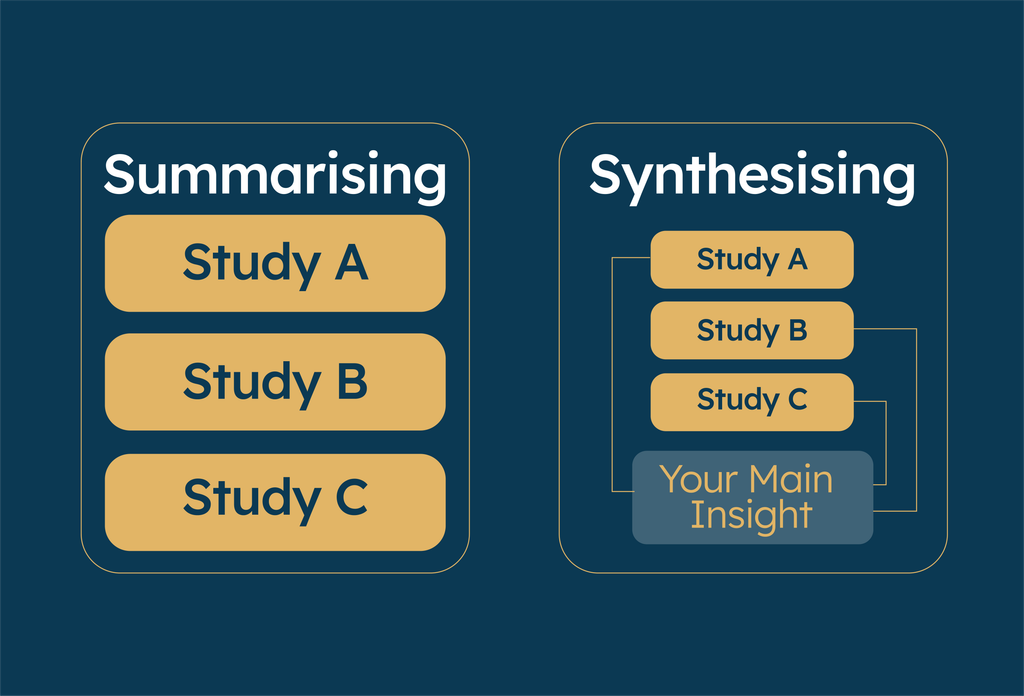
Before you can synthesise literature, you need to understand how it differs from summarising individual studies.
- Summarising means explaining what a particular researcher investigated and found.
- Synthesising means connecting findings from multiple studies to identify broader patterns, differences, relationships and insights.
Consider this example. Imagine you are researching the relationship between social media marketing and consumer purchasing behaviour.
A summary-style discussion might read:
Author A (2022) found that social media engagement positively influenced purchasing decisions. Author B (2023) examined influencer credibility and found that consumers were more likely to trust brands recommended by credible influencers. Author C (2024) investigated digital marketing and reported that its influence varied across consumer groups.
This tells readers what each researcher found, but it does not fully explain how the findings relate.
A synthesised discussion might read:
Previous studies suggest that social media marketing can influence consumer purchasing behaviour through different mechanisms. While Author A (2022) identifies social media engagement as an important factor, Author B (2023) highlights the role of influencer credibility in building consumer trust. However, Author C (2024) suggests that these effects may vary across consumer groups. Taken together, the studies indicate that consumer responses to social media marketing may depend on both the content they encounter and how they perceive and engage with it.
The second example connects the studies and draws an interpretation from their combined findings. That is the difference between simply reporting research and developing an academic discussion.
2. Look for Connections Between Previous Studies
Once you have gathered relevant studies, begin examining how they relate to one another. Do not read each paper as an isolated piece of information. Look for connections across the literature.
Here are four useful things to examine:
A. Similar findings
Do several researchers report similar results? For example, multiple studies may suggest that consumer trust influences purchasing decisions. You can bring these findings together to explain the pattern emerging from the literature.
B. Contradictory findings
Not all researchers will reach the same conclusion. One study may report a positive relationship between two variables, while another finds no significant relationship. Rather than ignoring these differences, discuss them, consider whether the studies differ in their research context, sample, methodology or measurement.
C. Different research approaches
Researchers may investigate similar questions using different methods. For example, one study may use questionnaires while another uses interviews. Consider what each approach contributes to understanding the problem and whether their findings offer complementary perspectives.
D. Areas that remain unclear
Some studies may provide useful findings while leaving other aspects of the problem unexplained. Pay attention to these limitations and unanswered questions. They may help you identify areas that require further investigation.
3. Use a Literature Comparison Table
Comparing studies becomes easier when you organise their findings in one place.
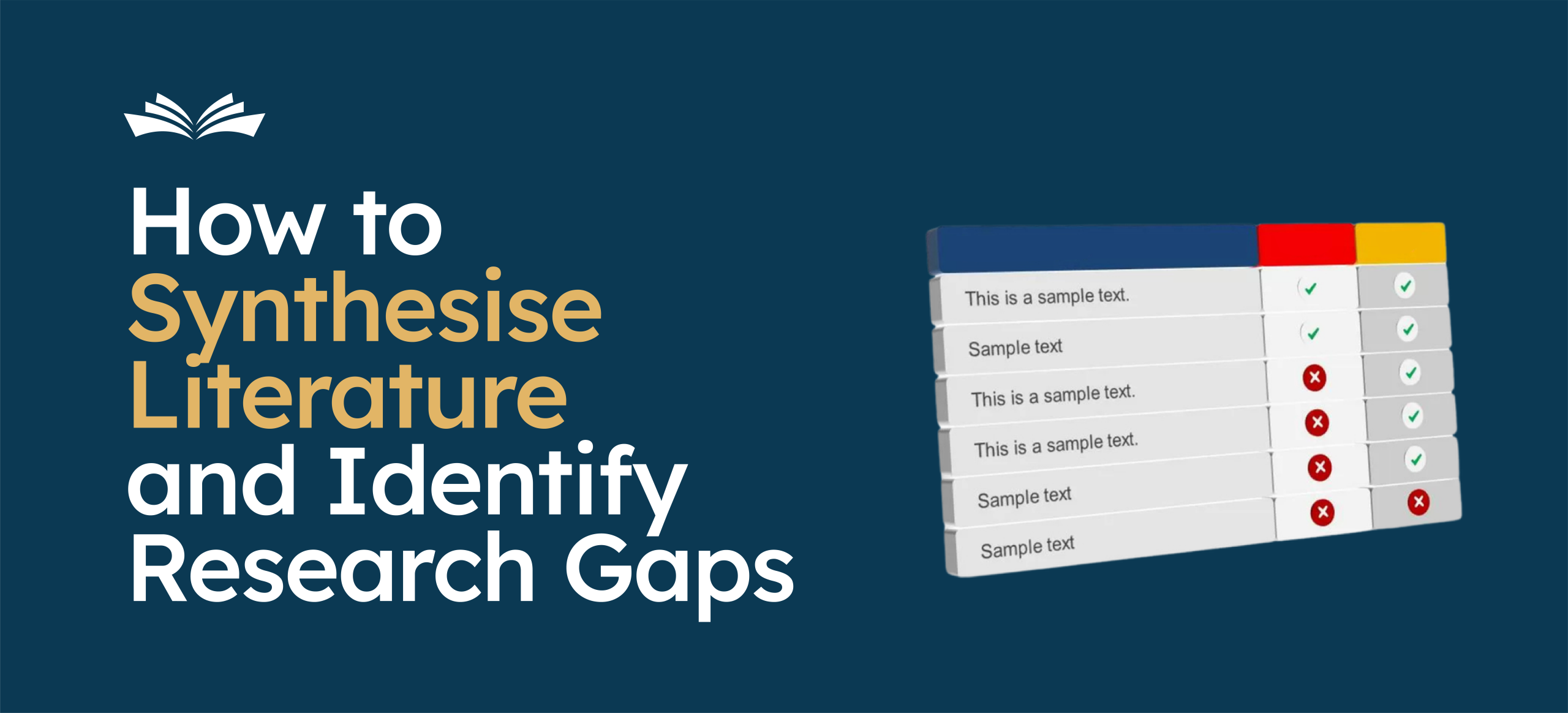
A simple comparison table can help you see where researchers agree, differ or leave questions unanswered.
| Study | Main finding | What it contributes |
|---|---|---|
| Study A (2022) | Reports a positive relationship between engagement and purchasing decisions | Establishes the relevance of engagement |
| Study B (2023) | Identifies consumer trust as an important factor | Introduces another possible influence |
| Study C (2024) | Finds that the relationship varies across consumer groups | Shows that the relationship may depend on context |
These are illustrative examples, not actual research findings.
After completing the table, ask yourself:
- What findings appear consistently across the studies?
- Where do the researchers disagree?
- Are there differences in their research methods or contexts?
- What questions have not been adequately answered?
Your answers will help you move beyond individual study summaries and develop a connected discussion.
4. How to Identify a Research Gap
A research gap is an aspect of a research problem that existing literature has not sufficiently addressed. It provides a reason why further investigation may be necessary.
However, identifying a research gap is not simply about finding a topic that has not been studied before. You need to understand the existing research and establish what remains unexplored or insufficiently explained.
Here are some common types of research gaps.
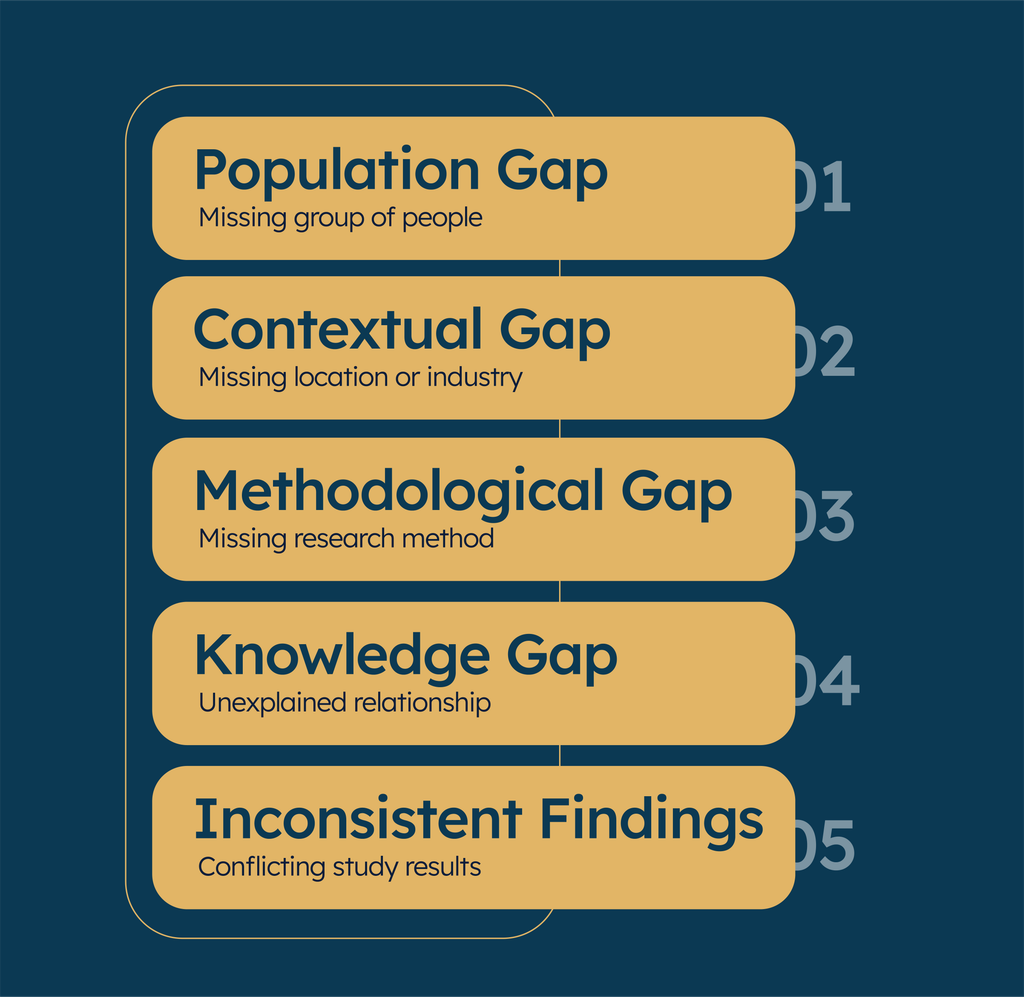
1. Population gap
Previous studies may have focused on particular groups while giving limited attention to another relevant population. For example, several studies may have examined social media marketing among university students, while less attention has been given to purchasing behaviour among small business owners.
2. Contextual gap
A research topic may have been investigated in certain geographical locations, industries or institutional settings but not sufficiently explored in another relevant context.
3. Methodological gap
Previous studies may have relied on particular research methods, creating a reasonable opportunity to investigate the problem using another suitable approach.
4. Knowledge gap
Existing studies may not adequately explain a particular relationship, process or aspect of a research problem.
5. Inconsistent findings
Previous studies may report different or conflicting results, suggesting that further investigation is needed to understand the relationship more clearly.
Not every difference in findings automatically represents a research gap. You need to examine the studies carefully and establish why the difference matters.
5. How to Connect Your Research Gap to Your Own Study
Identifying a gap is only part of the process. You must also explain how your research will address it.
A research gap should connect naturally to your research problem, objectives and questions.
For example, imagine your review shows that previous studies have examined social media marketing and consumer purchasing behaviour, but most of the studies you reviewed focused on university students. Your discussion might establish that there is a need to investigate the relationship within another relevant population.
Your own study could then be designed to examine that relationship in the selected population, provided your wider literature search confirms that the gap is genuine.
To make this connection, ask:
- What has already been established?
- What remains insufficiently understood?
- Why does this unanswered question matter?
- How will my research investigate it?
Your research gap should be supported by the literature you reviewed, not introduced as an unsupported statement.
How Thesis SpeedWrite Can Support Your Literature Review
Synthesising literature requires more than collecting references. You need to work through the sources, understand their relevance and recognise how they connect to your research.
Thesis SpeedWrite provides tools that can support this process.
- Master Reference Library: Helps you manage and organise your research references so you can work with your sources more systematically.
- Literature Mapping: Helps you work through relevant literature and understand how existing research connects to your study.
- Writing Studio: Provides a space to develop your thesis sections as you build your academic discussion.
These tools support your research workflow, but identifying a genuine research gap still requires critical reading, careful evaluation and your own academic judgement.
You must determine whether the evidence supports your interpretation and whether the gap you identify provides a meaningful basis for your study.
Conclusion
A strong literature review is not simply a collection of everything you have read. It is a connected discussion that explains what existing research reveals about your topic and what still needs to be understood.
Learn to compare studies, recognise patterns, examine differences and question what the existing literature leaves unanswered.
Most importantly, make sure your research gap emerges from the evidence you have reviewed.
When you can explain what previous researchers have established, where their findings differ and what remains unexplored, you are in a much stronger position to establish the purpose of your own research.
Working through your literature review? Explore Thesis SpeedWrite and see how Literature Mapping and the Master Reference Library can support the way you work with academic literature.