You have gathered your journal articles, organised your references and identified the major themes related to your research. You may even have an outline for your literature review.
But when you finally open your document to start writing, you are not sure how to turn all that information into a proper academic discussion.
Should you start with the first article you read? How do you arrange your paragraphs? How much information should you include? And how do you make sure your writing sounds like a literature review rather than a collection of research summaries?
Writing a literature review requires more than gathering information from different sources. You need to present that information clearly, support your discussions with credible evidence and maintain a logical flow throughout the chapter.
This guide explains how to approach the writing process and the common mistakes to avoid.
1. Start With a Clear Outline
Before writing full paragraphs, create an outline for your literature review. Your outline should show the major sections of the chapter and the ideas you intend to discuss under each one. For example, if your research examines the influence of social media marketing on consumer purchasing behaviour, your outline might look like this:
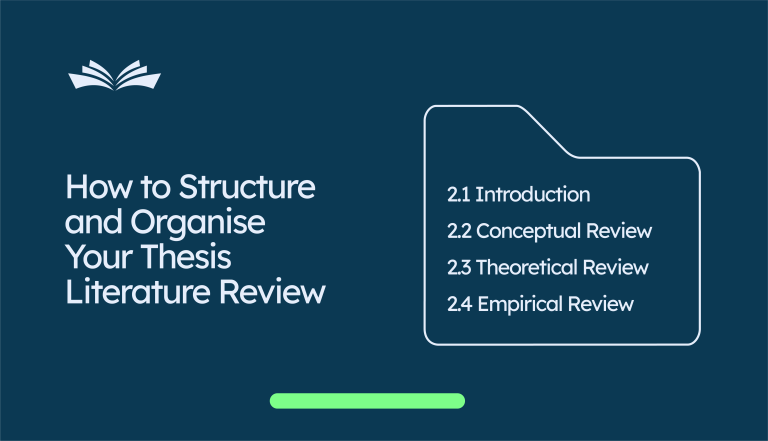
CHAPTER TWO: LITERATURE REVIEW
- 2.1 Introduction
- 2.2 Conceptual Review
- 2.2.1 Social Media Marketing
- 2.2.2 Consumer Purchasing Behaviour
- 2.2.3 Dimensions of Social Media Marketing
- 2.3 Theoretical Review
- 2.4 Empirical Review
- 2.5 Summary of Literature Review
This gives your writing direction and helps prevent unrelated discussions from finding their way into the chapter. Remember to adapt the outline to your research objectives and departmental requirements.
2. Write One Section at a Time
Trying to write the entire literature review at once can make the process overwhelming. Instead, work through your outline section by section. For each subsection, identify:
- The main idea you want to explain.
- The academic sources that support the discussion.
- The important arguments or findings to include.
- How the discussion relates to your research.
For example, if you are writing about social media marketing, you could begin by explaining the concept, discuss how different scholars define it, and then introduce the dimensions relevant to your study. This creates a natural progression instead of jumping between unrelated ideas.
3. Build Clear and Connected Paragraphs
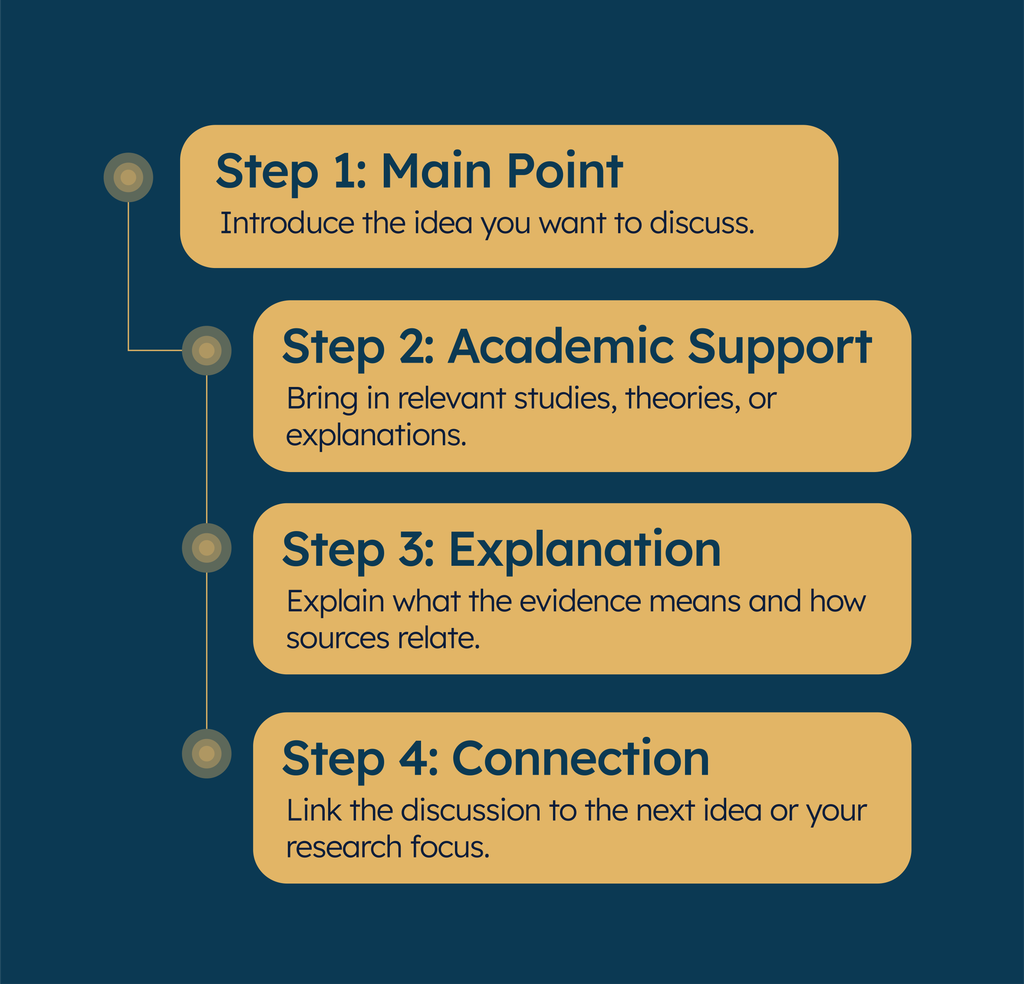
A good literature review paragraph should communicate a clear idea and support it with relevant academic evidence. One useful approach is to structure your paragraphs around four elements:
1. Main point: Introduce the idea you want to discuss.
2. Academic support: Bring in relevant studies, theories or scholarly explanations.
3. Explanation: Explain what the evidence means and how the sources relate to the discussion.
4. Connection: Link the discussion to the next idea or the wider focus of your research.
For example:
Consumer trust is an important consideration in online purchasing behaviour because it can influence how individuals respond to products and brands they encounter digitally. Previous studies have examined the relationship between trust and purchasing decisions, highlighting its relevance to consumer behaviour in online environments. These findings suggest that understanding consumer purchasing behaviour requires attention not only to marketing activities but also to the perceptions and confidence consumers develop towards brands.
This is an illustrative paragraph. In your actual thesis, the claims should be supported with appropriate academic sources and citations. The aim is to make each paragraph contribute something meaningful to the overall discussion.
4. Use Academic Sources Without Losing Your Own Voice
Your literature review should be supported by existing research, but that does not mean every sentence needs to be a quotation or a direct reproduction of another author’s explanation. You should demonstrate that you understand the literature by explaining relevant ideas in your own academic writing.
For example:
Less effective:
According to Author A (2022), social media marketing influences consumer behaviour. Author B (2023) stated that social media marketing is important to businesses. Author C (2024) explained that social media platforms help companies reach customers.
A more connected approach:
Social media marketing has become an important part of how businesses communicate with consumers and promote their products. Existing studies have examined its influence on consumer engagement, brand communication and purchasing decisions (Author A, 2022; Author B, 2023; Author C, 2024).
The second example presents the discussion more naturally. However, only use grouped citations when the cited studies genuinely support the claim being made. Always check the original sources and follow your required referencing style.
5. Pay Attention to Flow and Transitions
A literature review should read like one connected chapter, not several unrelated sections placed together. Transitions help readers understand how one idea relates to the next.
For example, you can use expressions such as:
- Furthermore, previous studies have examined…
- In a similar context…
- However, other researchers have reported…
- Beyond this relationship…
- These findings provide a basis for examining…
Use these expressions naturally. Avoid repeating the same transition at the beginning of every paragraph. More importantly, make sure the relationship between the ideas is clear. A transition cannot replace an actual connection between arguments.
6. Common Literature Review Writing Mistakes to Avoid
Even when you have relevant sources and a good outline, certain writing habits can weaken your chapter.
Mistake 1: Writing everything you find
Not every interesting article belongs in your literature review.
What to do instead: Include sources that contribute to the concepts, theories, relationships or research questions relevant to your study.
Mistake 2: Writing excessively long paragraphs
Long paragraphs that contain several unrelated ideas can make your discussion difficult to follow.
What to do instead: Give each paragraph a clear focus. Start a new paragraph when you move to a different idea or aspect of the discussion.
Mistake 3: Overusing direct quotations
Too many quotations can make the chapter feel like a collection of other people’s words.
What to do instead: Paraphrase and explain relevant academic ideas in your own words while providing accurate citations. Retain direct quotations where the original wording is important.
Mistake 4: Repeating the same explanations
Repeating definitions or arguments across different sections makes the chapter unnecessarily lengthy.
What to do instead: Give each subsection a distinct purpose and refer back to earlier discussions where necessary instead of explaining the same concept repeatedly.
Mistake 5: Using citations without checking the original source
A citation may look correct but still misrepresent what the original study actually established.
What to do instead: Verify the source, check the relevant passage and ensure that your interpretation accurately reflects the author’s work.
Mistake 6: Ignoring your institution’s formatting requirements
Your department may have specific expectations for headings, numbering, referencing style, spacing and chapter organisation.
What to do instead: Check your departmental guidelines and supervisor’s instructions before finalising the chapter.

7. Review and Improve Your Literature Review Draft
Your first draft does not have to be perfect. Once you have written the chapter, set aside time to review it.
Read through your work and check the following:
- Does each section relate to my research topic?
- Are my paragraphs focused on clear ideas?
- Have I supported academic claims with appropriate sources?
- Are my citations accurate and consistent?
- Do the sections flow logically?
- Have I repeated information unnecessarily?
- Does the chapter follow my institution’s requirements?
You should also check grammar, sentence clarity, referencing and formatting. Where possible, read the chapter as someone encountering your research for the first time. Can they understand the discussion and follow how the ideas connect?
How Thesis SpeedWrite Can Support Your Literature Review Writing
Writing a literature review involves several connected activities, from managing academic references to organising your research and developing your thesis sections.
Thesis SpeedWrite provides tools that support these stages:
- Master Reference Library: Helps you manage and organise your research references.
- Literature Mapping: Helps you work through relevant literature and understand how existing research connects to your study.
- Writing Studio: Provides a space to work through your thesis sections as you develop your writing.
Together, these tools support a more organised research workflow. They do not replace your responsibility to read, evaluate evidence, develop arguments and make academic decisions. Your literature review should reflect your understanding of the research, not simply reproduce information from your sources.

Part of Thesis Speedwrite? You can now Earn while writing your Thesis
Conclusion
Writing a strong literature review becomes more manageable when you approach it systematically.
Start with a clear outline, work through your sections one at a time, develop focused paragraphs and support your discussions with credible academic sources. Once your draft is complete, review it for clarity, flow, accuracy and consistency.
Remember, the goal is not simply to fill pages with information. It is to develop a well-organised academic discussion that helps readers understand the existing knowledge surrounding your research.
Ready to make your thesis writing process more organised? Explore Thesis SpeedWrite and discover how its research planning, Master Reference Library, Literature Mapping and Writing Studio can support your journey.
Frequently Asked Questions
1. How do I start writing a literature review?
Start by reviewing your research objectives, organising your sources and creating an outline. Then work through each section systematically, using relevant academic literature to support your discussion.
2. How long should a thesis literature review be?
There is no universal length. It depends on your academic level, discipline, research scope and institutional requirements. Focus on covering the relevant literature adequately rather than writing to reach a particular page count.
3. Can I use my own words when writing a literature review?
Yes. You should explain and discuss academic ideas in your own words while acknowledging the original authors through appropriate citations.
4. How many studies should I include in my literature review?
There is no fixed number. Include enough relevant and credible studies to establish the existing knowledge surrounding your research problem and support your discussion.
5. Should I write my literature review in the past or present tense?
Both may be appropriate depending on what you are discussing and your discipline’s conventions. For example, you might use the past tense to describe what a particular study investigated, while using the present tense to discuss established concepts or explain what the literature suggests. Follow your department’s preferred academic style.