It is past nine in the evening, the house has gone quiet, and you open the thesis folder for the first time in days. The last file was saved three weeks ago, your supervisor’s email is still unanswered, and one number keeps repeating in your head: 30 days left to finish my thesis.
Quick answer: you can finish a full draft in 30 days if your data is already collected. Deal with the dread in the first two days, build a rough skeleton in week one, fill it in over weeks two and three, and use week four to polish and submit. You are aiming for a complete draft, not a masterpiece.
Table of Contents
What You Are Feeling With 30 Days Left to Finish My Thesis
If any of these sound familiar, you are in good company:

- Dread: you think about the thesis all day and work on it rarely.
- Guilt: rest feels stolen, and desk time never feels like enough.
- Avoidance: you answer every email and tidy the house to avoid opening the file.
- Shame: you have not told your supervisor how far behind you are.
None of this makes you lazy. The mind avoids anything both huge and vague, and “finish the thesis” is exactly that. The fix is to make the task small and specific enough to start, which is what the plan below does.
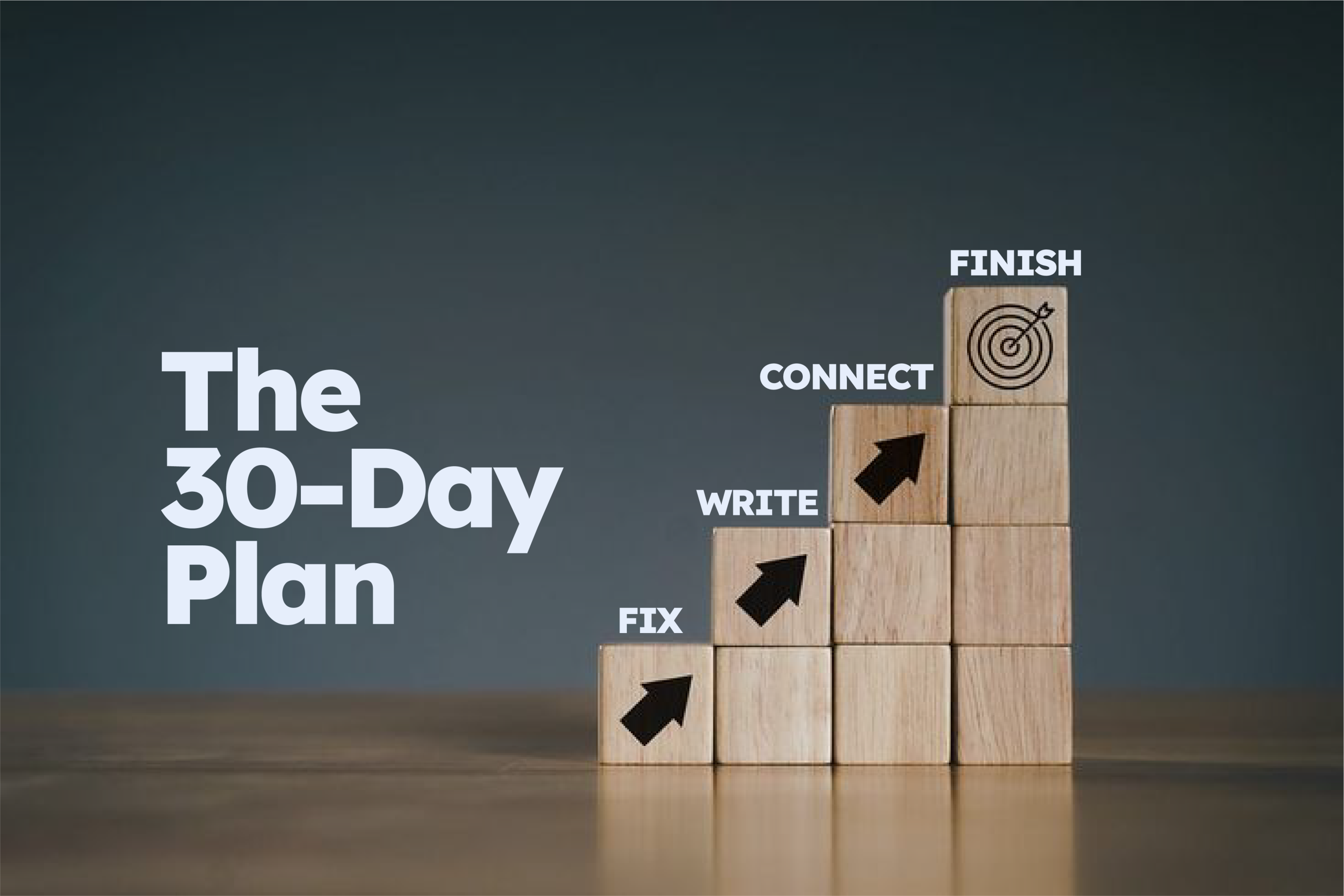
The Plan at a Glance
- Days 1 and 2: open everything, sort your chapters, email your supervisor
- Week 1: map the skeleton and write methodology and results
- Week 2: write the literature review and keep a steady daily count
- Week 3: discussion, conclusion, then the introduction last
- Week 4: trim, check, format and submit
Days 1 and 2: Replace Fear With Facts
- Open every chapter and mark each one as finished, stuck, or shaky. The real state is usually better than the one in your head.
- Email your supervisor with where you are, what is left, and when you will send the next piece. Ask how long their feedback usually takes.
- Ask for time off work now if you need it. A request made early sounds like planning, and one made in week four sounds like an emergency.
- Do the word math: take the words you need, subtract what you have, and divide by 18 usable writing days. If you need 15,000 words and have 6,000, that is 9,000 left, or 500 a day.
If Your Data Is Not Ready
- Settle methodology and analysis first, before any new writing, because everything rests on them.
- Check that your research questions can actually be answered by the data you have.
- Drop a secondary question with your supervisor if it is putting the main one at risk.
- If collection is still unfinished, narrow the scope or ask for a short extension in week one or two, with a written plan attached.
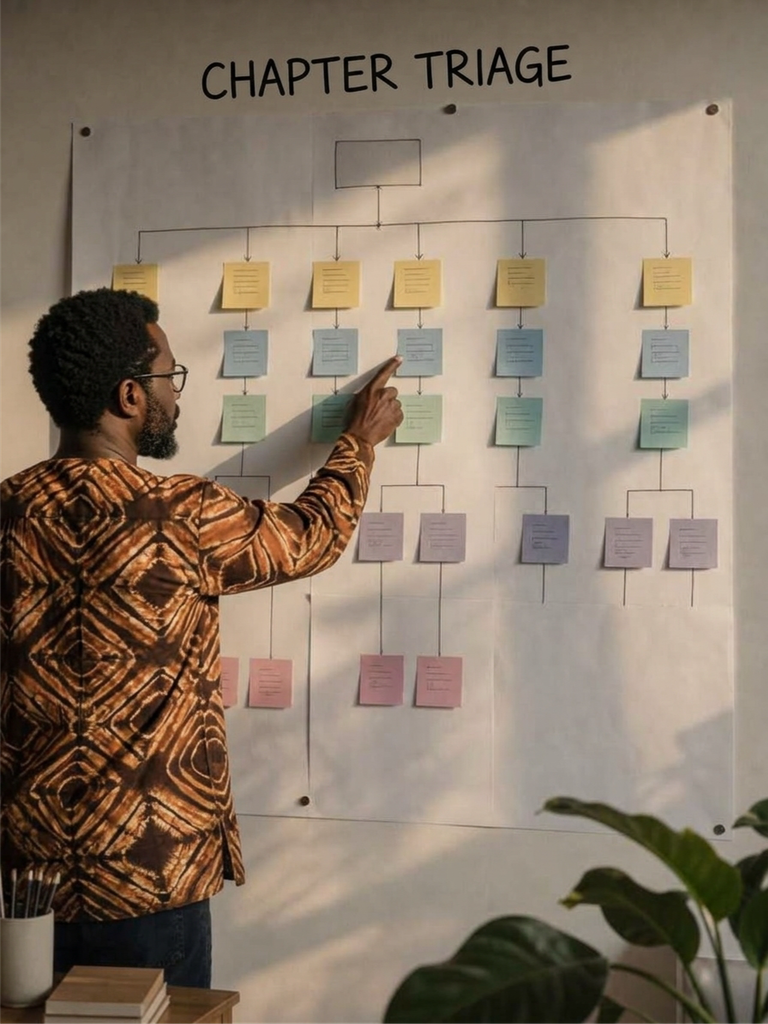
HOW TO PLAN YOUR CHAPTERS WEEK BY WEEK
Week 1 (Days 3 to 7): Map the Skeleton
- Find your red thread: write the single argument that links your introduction to your conclusion in a few plain sentences, and keep it visible.
- Write from the inside out: start with methodology and results, since you already know what you did and found.
- Allow a bad first draft: “then I looked at the data and it went up” is a fine first sentence. Vocabulary can be fixed later, and a blank page cannot.
Week 2 (Days 8 to 14): Fill the Pages
- Group sources by theme instead of summarising them one by one. Forty to eighty sources are manageable this way.
- Limit deep reading, since you are building an argument, not a library.
- Write first, cite later: drop a [CITE] placeholder and add references in batches every 500 to 1,000 words.
- Keep a running list of every placeholder and source, because forgotten ones are how citation errors and accidental plagiarism happen.
- Working full time? A protected 90-minute block at the same time each day usually beats a plan that needs a free weekend.
Week 3 (Days 15 to 21): The Heavy Lifting
- Draft the discussion and conclusion: why your results matter, how they fit the literature, and what research should do next.
- Write the introduction last, so it promises exactly what the thesis delivers.
- Send chapters to your supervisor as you finish them, because feedback can take two to three weeks.
- Alternate heavy and light days, mixing drafting with editing, to avoid burning out.
Week 4 (Days 22 to 30): Polish, Format and Submit
- Stop adding new material and focus on grammar, tighter sentences and your department’s style guide.
- Check tables, figure labels and the bibliography against the text.
- Clear every [CITE] placeholder so nothing is left unsourced.
- Confirm the final requirements with your department, including whether supervisor review comes before submission.
- Start defence scheduling early if a panel has to be convened.
Where AI Fits When You Are Short on Time

AI should never replace the researcher. AI should strengthen the researcher. With 30 days left to finish my thesis, handing everything to a tool is tempting, and it is the move most likely to cost you at your defence.
- AI can help you: organise scattered notes, spot gaps in your argument, untangle a paragraph, and think through how to frame a stuck section.
- AI cannot: choose your methodology, interpret your data, or make the academic judgements your degree is meant to prove you can make.
Thesis SpeedWrite is built on that thinking. It guides you through the research stages so you always know the next step, without doing the thinking for you.
Realistic Expectations
- You will have bad days, maybe three, and the small daily target allows for them.
- You will probably cut something, such as a secondary question or an extra chart, and that protects the argument that matters.
- Good beats perfect: you can strengthen a submitted thesis at the defence and publication stage.
- If week two shows it cannot work, ask for an extension then, with a written plan, not in the final days.
Start Tonight
You do not have to feel ready. You need 15 minutes to open your chapters, a short list of what is done and what is not, and one honest email to your supervisor. If your thought tonight is “30 days left to finish my thesis,” that is enough for today.
Thesis SpeedWrite guides you through the research stages, coaching can help when a decision has you stuck, and Editer can sharpen the draft once it is complete. You do the thinking and the finishing, and thirty days is enough for that.