How to Start Your Thesis When You Don’t Know Where to Begin: A Student’s Research Journey
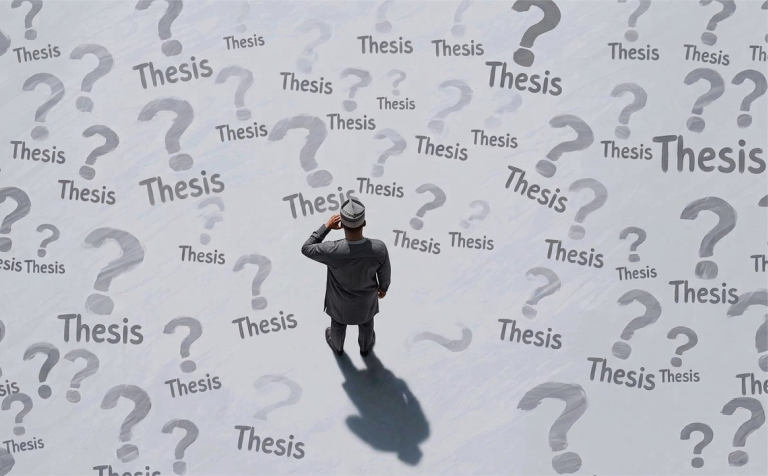
“I don’t even know where to start.”
If you’re wondering how to start your thesis when nothing feels clear yet, you’re already asking the right question. It’s one of the most common sentences you’ll hear from a student beginning a research project.
Not because they’re lazy, unintelligent, and certainly not because they’re incapable of doing research. Most often, it’s because no one has shown them what the research journey actually looks like.
Let’s follow the story of Ada, a student whose experience reflects what thousands of undergraduate, master’s, and PhD researchers go through every year.
📌 In this article, you’ll learn:
- How to Start Your Thesis When You Don’t Know Where to Begin: A Student’s Research Journey
- Why starting a thesis feels so overwhelming, even for capable students
- The most common mistake students make in their first few weeks
- What separates research journeys that stay on track from ones that stall
- Five habits every successful thesis process has in common
- Why access to more information (and more AI tools) hasn’t made starting any easier
Table of Contents
The Excitement
Ada had just received approval to begin her thesis. She was motivated. She had ideas, bookmarked articles, downloaded AI tools, and promised herself she would “stay ahead” this time. For a few days, everything felt possible. Then reality arrived.
Her supervisor asked for a research topic. She had five ideas. None felt quite right. Every time she thought she had found one, another question appeared.
“Is it researchable?”
“Has someone already done this?”
“Is it too broad?”
“Will there be enough literature?”
Within a week, excitement had turned into uncertainty.

The Mistake Most Students Make
Like many researchers, Ada assumed the next step was to start writing. So she opened a blank document, then ChatGPT, Google Scholar, YouTube, then another PDF.
Before long, she had over 150 downloaded papers, several pages of notes, and multiple versions of Chapter One. Yet somehow, she felt further away from finishing than when she started.
The problem wasn’t a lack of effort, it was a lack of structure. Research doesn’t become easier because you collect more information. It becomes easier when you know what information you need, why you need it, and where it fits.
The Turning Point
Everything changed when Ada stopped asking, “What should I write next?”
Instead, she started asking, “What stage of the research process am I actually in?”
She realized research isn’t one giant writing task. It’s a sequence of connected decisions. Each stage prepares the next. When those stages are skipped or completed out of order, students end up rewriting chapters, second-guessing themselves, and receiving feedback that feels impossible to act on.
That shift, from staring at a blank page to knowing how to start your thesis one decision at a time, is what actually gets students moving
What Every Successful Research Journey Has in Common
Although every thesis is different, successful research journeys usually follow the same underlying pattern.
1. They begin with clarity, not writing
Before opening a document, successful researchers define the problem they’re solving, the scope of the study, the research questions, and the objectives guiding the work. Writing becomes easier when these foundations are clear.
2. They collect evidence with purpose
Strong researchers don’t download papers simply because they seem relevant. They gather literature that directly supports, challenges, or provides context for their research question. Every source has a role.
3. They connect ideas instead of collecting citations
Reading hundreds of papers isn’t the goal. Understanding how those papers relate to one another is. The strongest literature reviews don’t impress because they’re long, they persuade because they reveal patterns, agreements, contradictions, and gaps.
4. They write one connected argument
A thesis isn’t six separate chapters. It’s one continuous conversation. Every chapter should naturally build on the decisions made in the previous one. When that continuity exists, the writing flows.
5. They revise with intention
Feedback like “refine this” or “clarify your argument” becomes much easier to address when every section has a clear purpose within the overall research process. Revision becomes improvement, not starting over.
The Real Lesson
By the time Ada submitted her thesis, something had changed, and not because the research had become easy or because AI had done the work, and not because her supervisor had suddenly become less demanding.
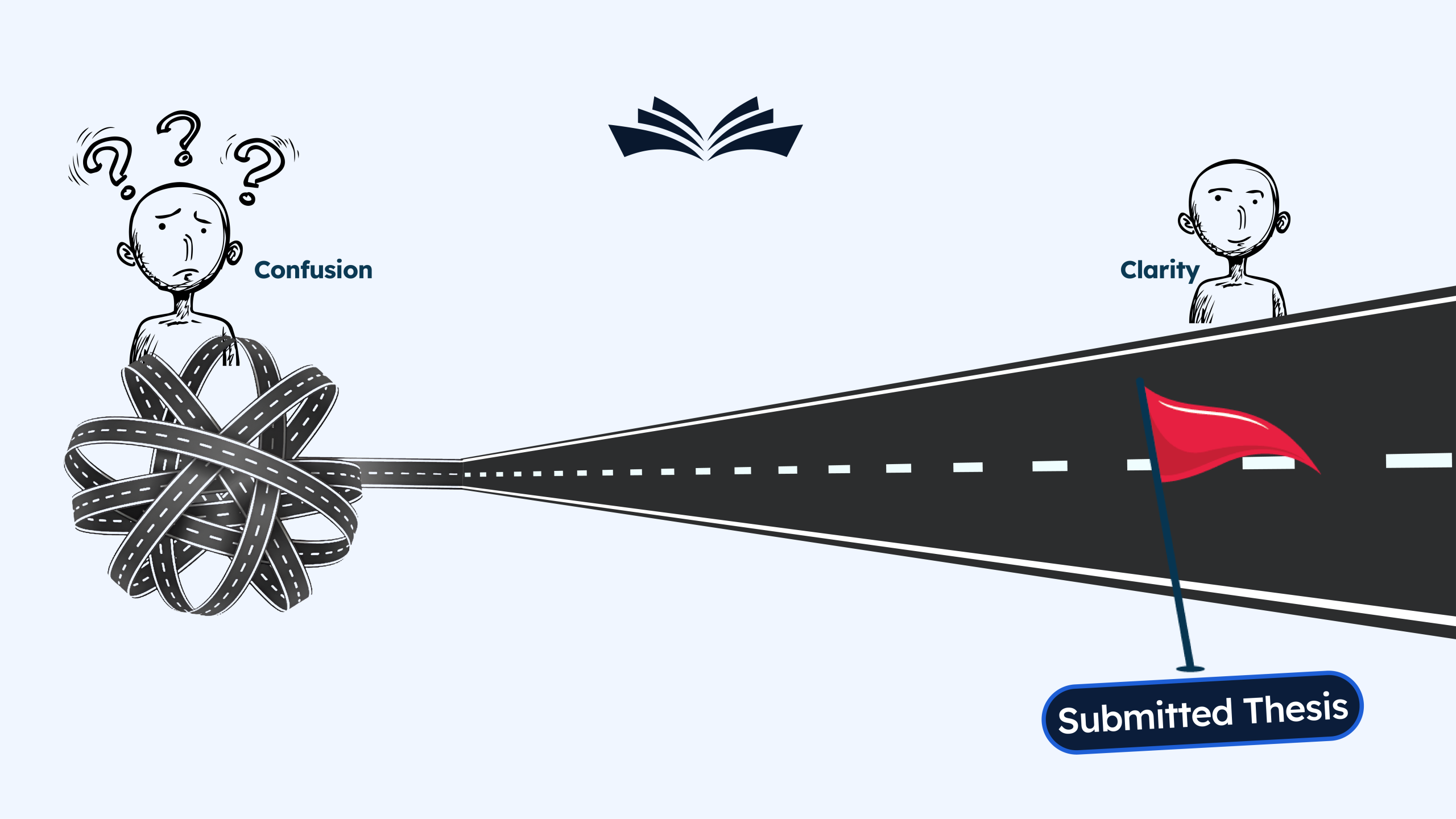
She had learned to trust a process instead of relying on guesswork. That’s the lesson many students miss. Research is rarely overwhelming because it’s too difficult. It’s overwhelming because students are expected to navigate a complex process without a map.
When you don’t know where you are, every decision feels uncertain. When you understand the journey, every step has a purpose.
Why This Matters More Than Ever
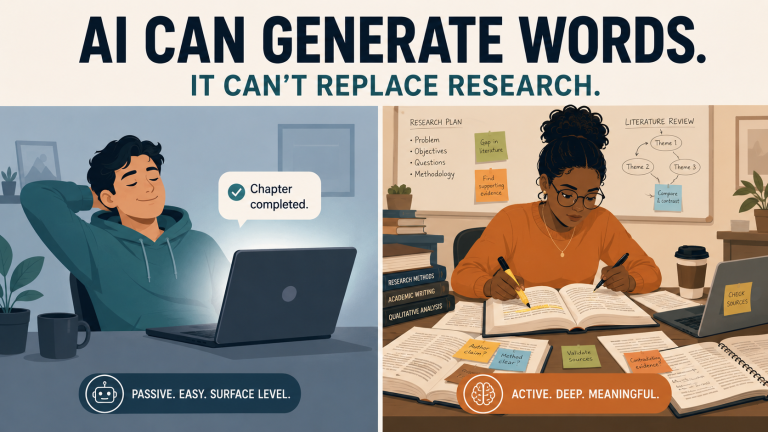
Today’s students have access to more information than any generation before them. They can generate outlines in seconds. Summarize papers instantly. Ask AI almost any question.
Yet many still struggle to complete their research with confidence.
Why? Because tools can generate content. They cannot replace a structured research process. Knowing what to write is different from knowing why it belongs there, and that’s the difference between producing a document and producing research you can confidently defend.
How to Start Your Thesis: A Better Way to Think About Research
The biggest transformation in research isn’t from blank page to finished thesis. It’s from “I don’t know where to start” to “I know exactly what comes next.”
At Thesisprofs, that’s the philosophy behind Thesis SpeedWrite not writing a thesis for students, but guiding them through the research journey one stage at a time. Combined with one-on-one coaching, professional editing through Editer, and publishing support through our Journal Hub, the goal is simple: help researchers produce work they understand, defend, and are proud to submit.

Frequently Asked Questions
Why is it so hard to start a thesis?
Starting feels hard because most students are asked to write without ever being shown the process behind good research. Once the stages of the journey are clear- defining the problem, gathering purposeful evidence, mapping themes, and then writing, the starting point becomes much easier to identify.
What are the stages of writing a thesis?
Most theses move through the same core stages: clarifying the research problem and questions, planning the study, building a literature base, reading critically, mapping themes across sources, drafting, revising, and preparing for submission. Skipping or reordering these stages is usually what causes rework later.
How do I choose a thesis topic when nothing feels right?
Rather than searching for the “perfect” topic immediately, test each idea against a few questions: is it researchable, has it already been well-covered, is the scope realistic, and is there enough existing literature to build on? Narrowing through these questions is more productive than waiting for certainty to appear on its own.
How many sources should I read before writing my thesis?
There’s no fixed number, the goal isn’t volume, it’s purpose. A smaller set of sources that directly relate to your research question and that you can meaningfully connect to one another is more valuable than hundreds of loosely related papers.
Can AI help me start my thesis?
Yes, when used to support the process rather than replace it, for example, brainstorming angles on a topic, organizing references, or clarifying a confusing concept. AI can’t define your research problem or determine what your specific study actually needs, which is why a structured process still matters more than the tool itself.
How to start your thesis if you feel like you’re already behind?
Being behind schedule doesn’t change the process, it just means moving through the same stages with more urgency. Rushing straight to writing usually costs more time than it saves
Research Smarter, Not Just Faster
That’s the real answer to how to start your thesis, not a shortcut, but a process you can trust.
If you’re somewhere in the middle of your own research journey, where do you feel most stuck right now? Share it in the comments, we’d love to hear where you are and be of support.