Can You Use AI to Write a Thesis? Here’s What Every Student Needs to Know in 2026
Introduction
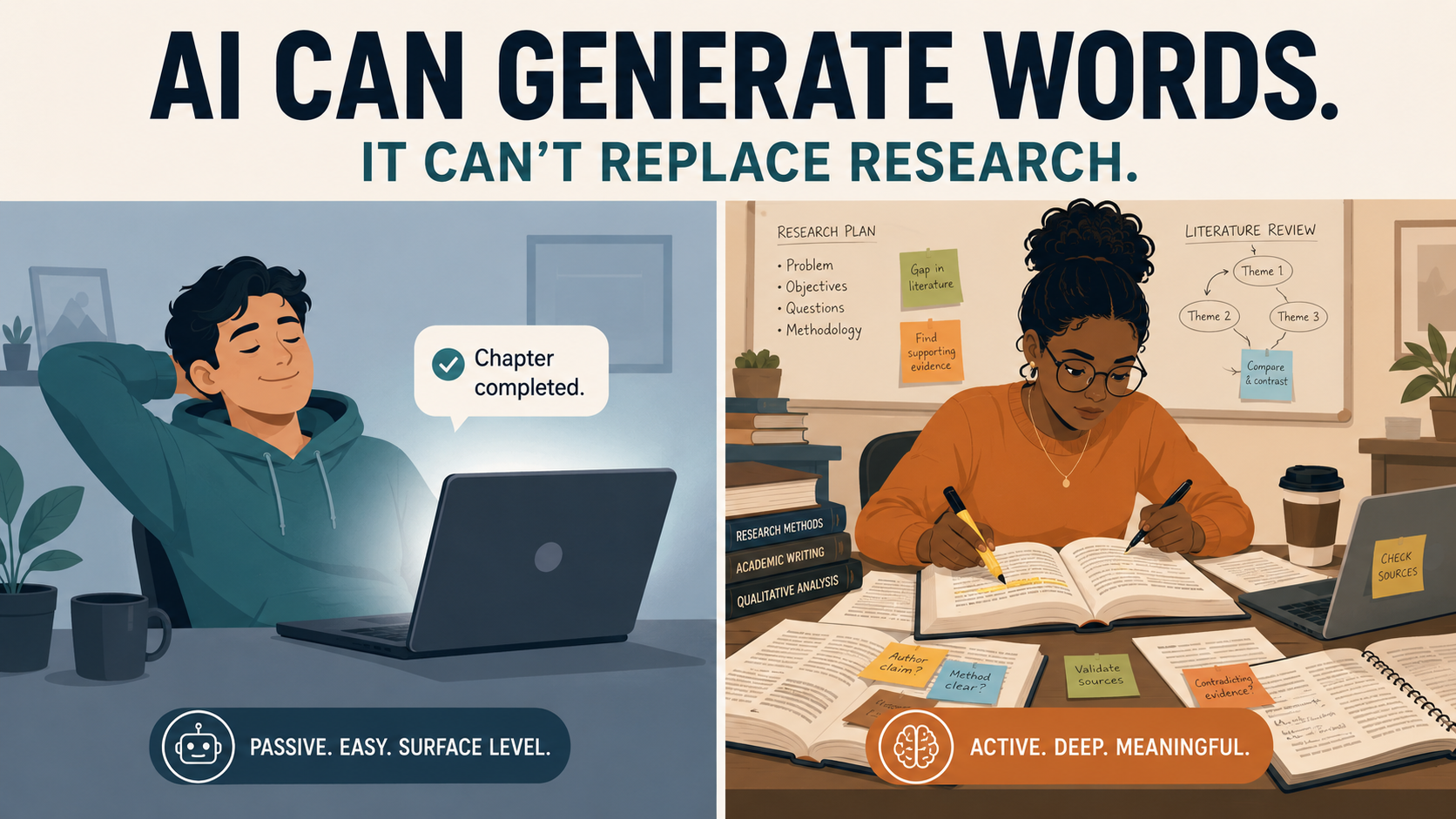
Imagine this. Your thesis deadline is six weeks away. You open ChatGPT and type: “Write Chapter One.” A few seconds later, you’re staring at 2,000 words. For a moment, it feels like you’ve solved your biggest problem. The blank page is gone. There’s a document. There’s progress.
But have you actually solved anything? Not quite, because writing a thesis and doing research are not the same thing. That gap is exactly where thousands of students get into trouble every year, sometimes without realizing it until a supervisor asks a question they can’t answer.
So the real question isn’t:
Can you use AI to write a thesis?
It’s:
Should it?

Student looking uncertain while reviewing AI-generated text on a laptop screenIn this guide, you’ll learn:
- What AI can and cannot do in academic research
- The ethical way to use AI in your thesis
- Common mistakes that lead to weak AI-assisted research
- How supervisors recognize overreliance on AI
- A practical workflow for combining AI with sound research practices
Why Everyone Is Asking This Question
A few years ago, this question barely existed. Now it’s everywhere.
ChatGPT, Claude, Gemini, Perplexity, and NotebookLM have all moved from novelty to daily habit for students and researchers alike. Universities have scrambled to write policies. Supervisors have changed how they read drafts. Students have started asking, quietly, whether the rules even apply to them the way they used to.
The honest answer is: research culture is going through a genuine shift, and nobody pretending otherwise is being straight with you.
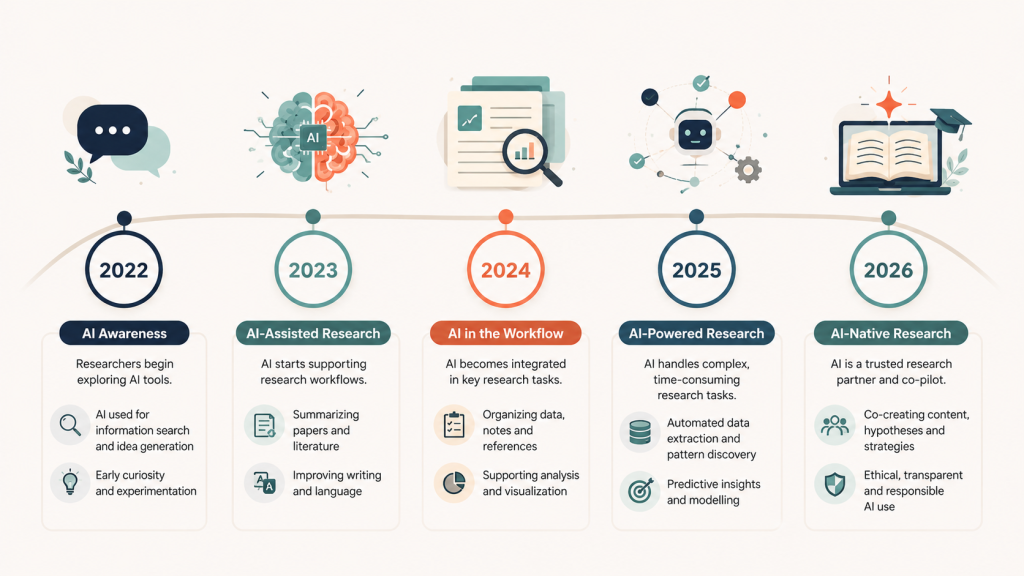
What hasn’t shifted, though, is what a thesis is actually for. A thesis exists to prove that you can identify a problem, engage with existing knowledge, design a way to investigate it, and defend your conclusions under scrutiny. AI tools are extraordinarily good at language. They are not a substitute for that underlying process, and that distinction is the entire subject of this article.
What AI Is Actually Good At
Let’s be clear about something first: this isn’t an anti-AI article. Fear isn’t a strategy, and pretending these tools don’t exist won’t help you write a stronger thesis.
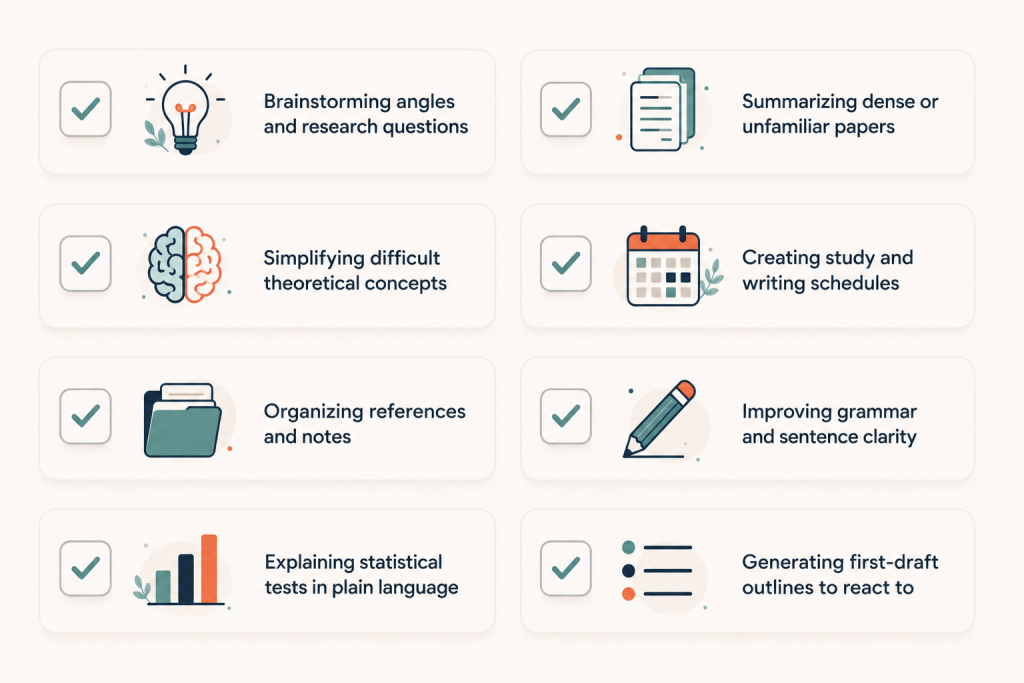
Used well, AI is genuinely useful for:
- Brainstorming angles and research questions
- Summarizing dense or unfamiliar papers
- Simplifying difficult theoretical concepts
- Creating study and writing schedules
- Organizing references and notes
- Improving grammar and sentence clarity
- Explaining statistical tests in plain language
- Generating first-draft outlines to react to
Notice what all of these have in common. They support the thinking. None of them replace it.
What AI Cannot Do
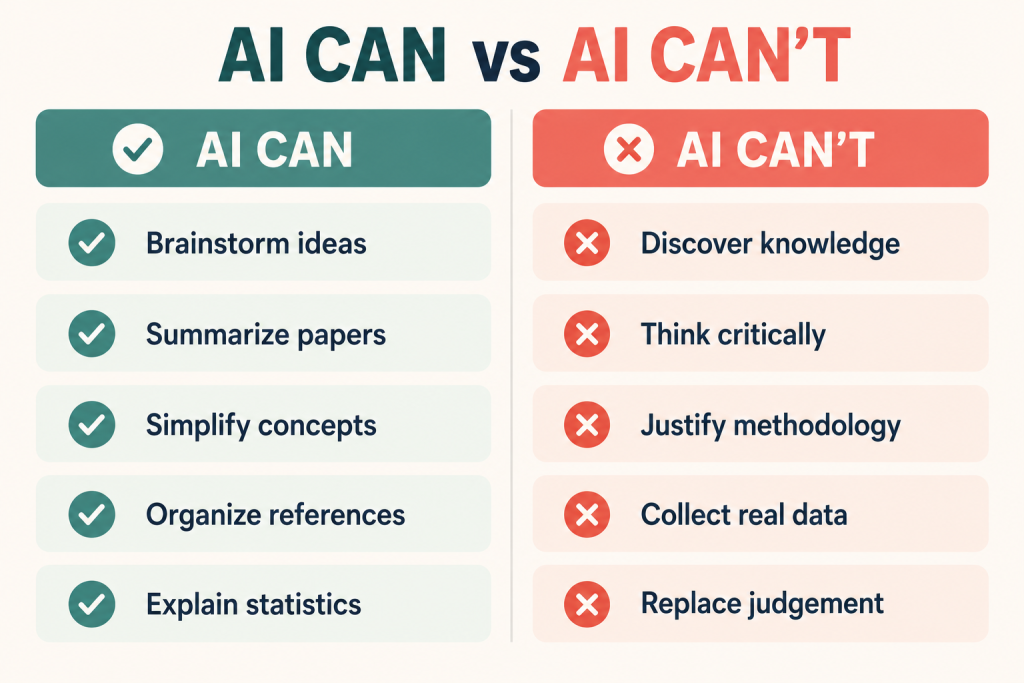
This is the part that matters most, so it’s worth sitting with. AI cannot:
- Discover new knowledge
- Conduct research
- Think critically on your behalf
- Justify a methodology to a review board
- Understand what your specific supervisor expects from you
- Collect original data
- Interpret context the way a human researcher does
- Replace academic judgement
A language model predicts plausible text. It doesn’t know your field the way you do after months of reading, and it has no stake in whether your argument is actually true. That distinction sounds abstract until it shows up as a fabricated statistic in your literature review, at which point it becomes very concrete, very fast.
The Biggest Risks of Letting AI Write Your Thesis
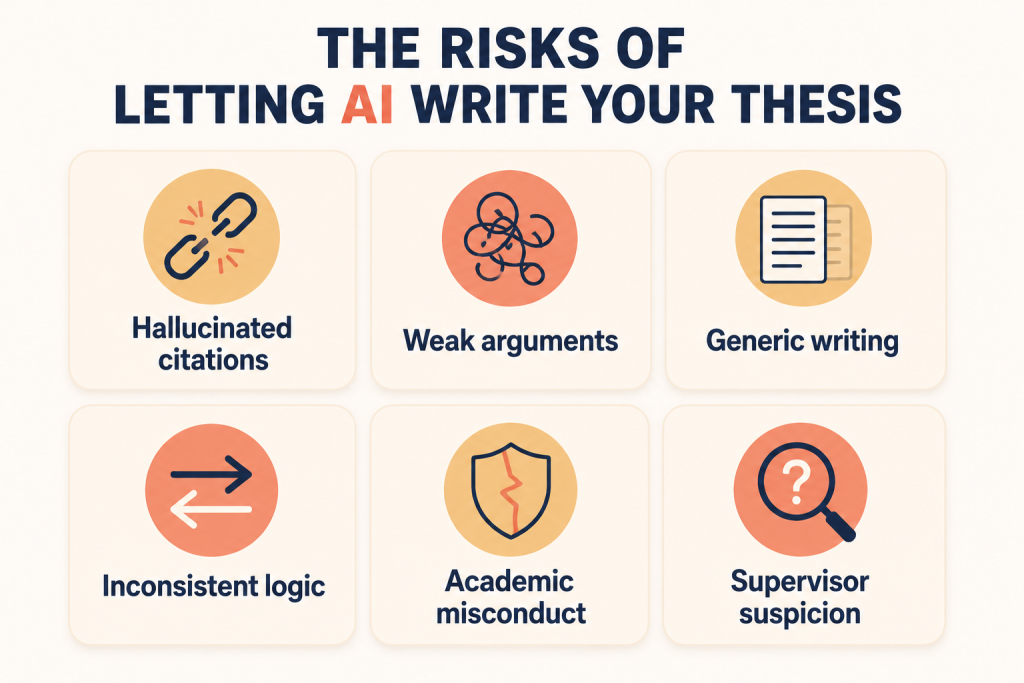
Handing entire chapters to AI doesn’t just risk getting caught. It risks producing work that’s quietly weak in ways you won’t notice until someone else does. The most common failure points:
- Hallucinated references — citations to papers that don’t exist, or that say something different from what’s claimed
- Weak arguments — confident-sounding prose with no real logical spine underneath
- Generic writing — technically correct sentences that say nothing distinctive
- Inconsistent logic — sections that contradict each other because no single mind held the whole argument
- Fabricated citations — a more serious version of hallucinated references, sometimes with invented page numbers or quotes
- Academic misconduct findings — many universities now treat undisclosed AI-generated text as a conduct violation, not just a quality issue
- Loss of understanding — you can’t defend, in a viva or oral exam, work you didn’t actually think through
- Supervisor suspicion — once trust is damaged, every future submission gets read more skeptically
None of these are hypothetical. They’re the most common reasons AI-heavy drafts get sent back or worse, flagged.
How Supervisors Spot AI Writing
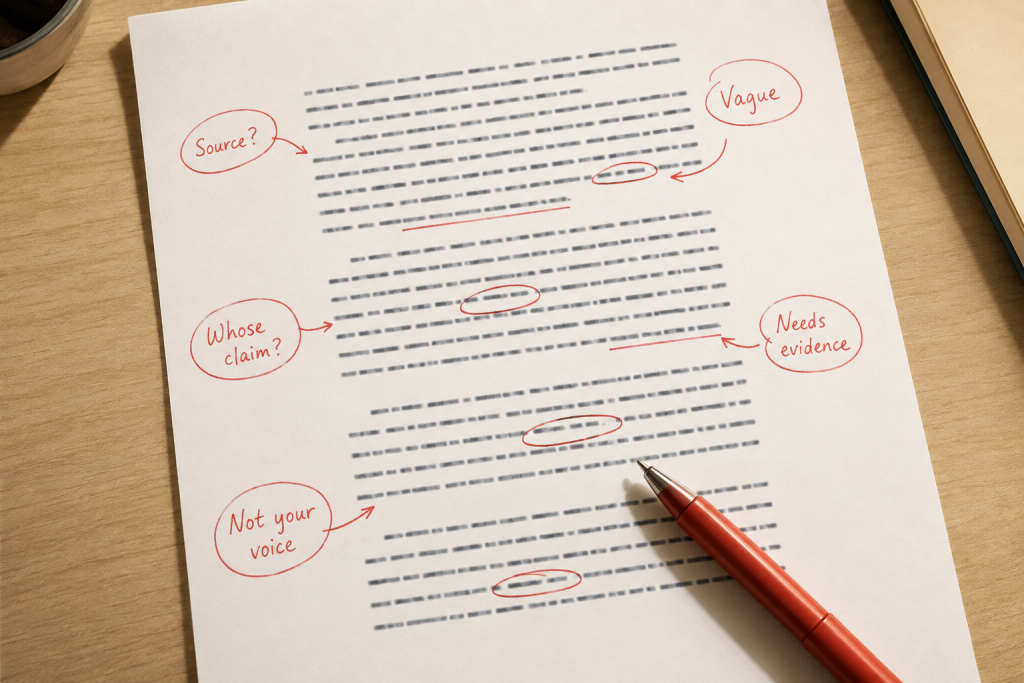
This is the section students usually find most useful, because it’s rarely explained honestly. Experienced supervisors read hundreds of drafts a year, and certain patterns give AI-generated sections away almost immediately:
- Generic transitional phrases that don’t connect to the actual argument
- An absence of real critical thinking — description instead of evaluation
- No synthesis across sources, just summary after summary
- No clear authorial position on contested points
- No distinctive voice — it could have been written by anyone, about anything
- Arguments that sound confident but collapse under a single follow-up question
- Over-explaining ideas that are obvious in the field, while under-explaining the genuinely hard parts
- Grammatically flawless prose that says remarkably little
If a paragraph could be dropped into a completely different thesis on a different topic and still make sense, that’s usually a sign it came from a model rather than from engagement with your specific data and argument.
The Ethical Way to Use AI
This is where the whole conversation changes, because the problem was never AI itself. It’s how it’s being prompted.
Compare these two approaches:
Instead of: “Write Chapter Two.”
Try:
- “Help me understand the debate between these two theoretical frameworks.”
- “Challenge my argument, what’s the strongest objection to it?”
- “Identify gaps in this set of studies I’ve gathered.”
- “Compare these two methodologies for my research question.”
- “Explain this statistical test in a way I can then explain to my supervisor.”
- “Improve the clarity of this paragraph without changing its meaning.”
- “Find the weakest point in this section of my argument.”
- “Suggest three questions a critical reviewer might ask about this claim.”
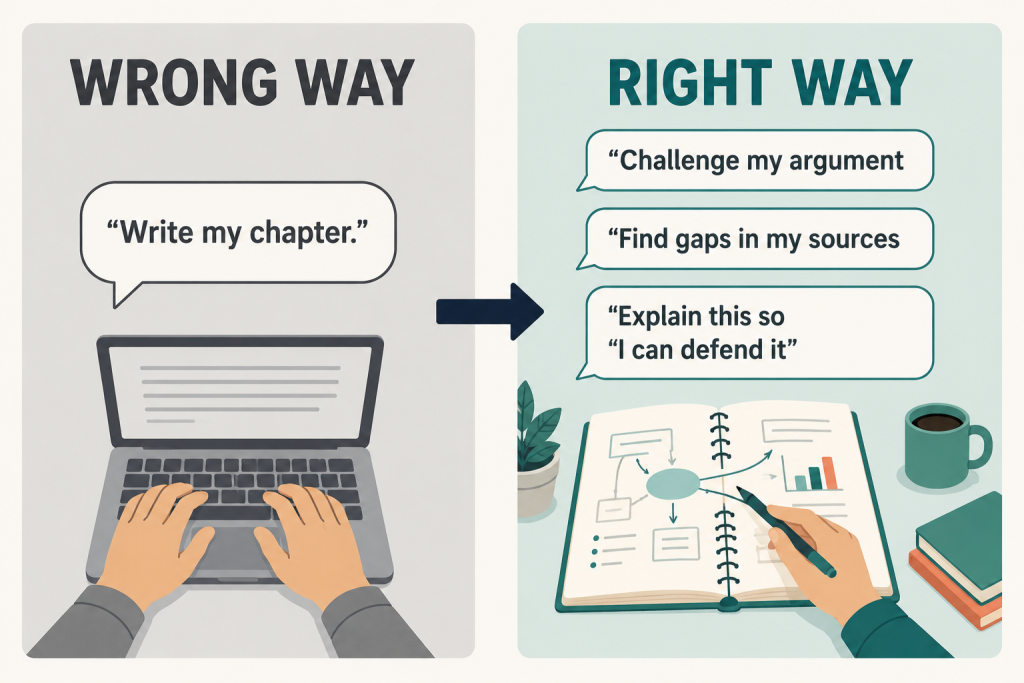
The first version outsources thinking. The second version uses AI the way a good research assistant would be used, to sharpen, question, and organize, while you remain the one doing the research.
Our Philosophy at Thesisprofs
Can you use AI to write a thesis?
We think this distinction deserves to be stated plainly:
AI should never replace the researcher. AI should strengthen the researcher.
That belief is the foundation of Thesisprofs SpeedWrite. It isn’t built to write your thesis for you. It’s built to guide you through planning, organizing, thinking, reviewing, and mapping your research, so that what ends up on the page is something you actually understand and can defend.
Writing is the easy part to automate. Thinking isn’t. That’s the part worth protecting, in order to answer the question.
A Practical Workflow
Here’s what a genuinely AI-assisted (not AI-generated) thesis process looks like in practice:
- Develop your topic — with AI as a brainstorming partner, not a decision-maker
- Plan your research — map out questions, scope, and methodology
- Build your literature library — organize sources systematically
- Read critically — engage with each source’s argument, not just its abstract
- Map themes — identify patterns and tensions across your reading
- Write — draft in your own voice, using AI to unblock, not to author
- Review — use AI to stress-test your argument and catch weak points
- Edit — refine clarity and structure
- Publish/submit — with full confidence you can defend every claim in it
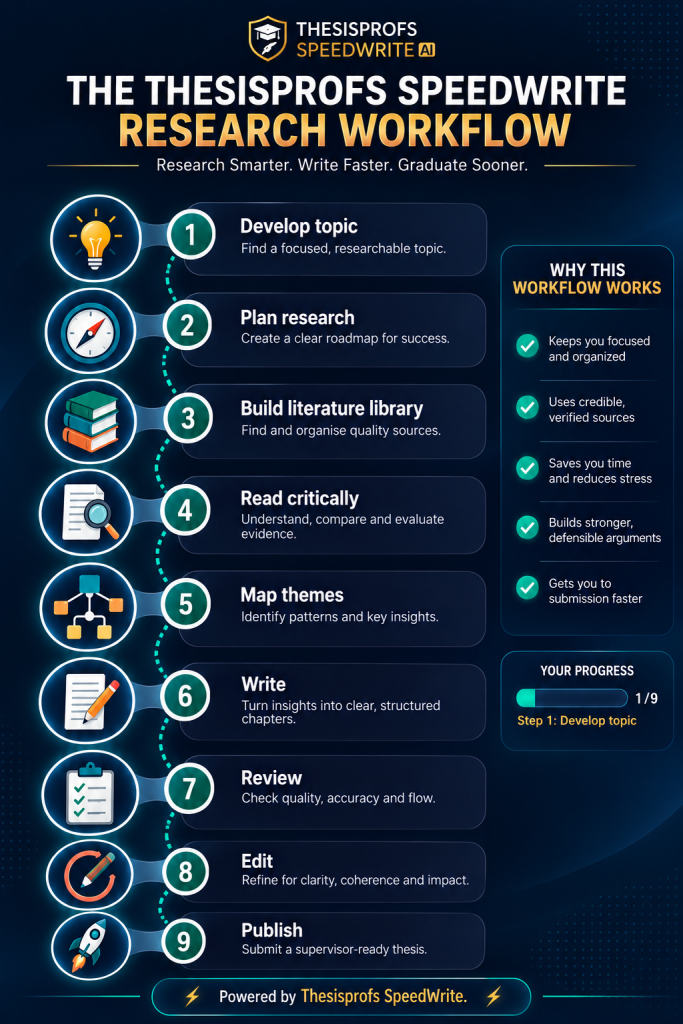
Each step still belongs to you. AI simply makes each one faster and less overwhelming.
Conclusion
Don’t ask: “Can I use AI to write my thesis?”
Ask instead: “How can AI help me become a better researcher?”
Those two questions lead to completely different outcomes. One leads to dependency, and eventually, to a thesis you can’t confidently stand behind. The other leads to mastery and to research you actually own.
Frequently Asked Questions
Can universities detect AI-generated writing?
Detection tools exist and are improving, but they’re imperfect and can produce false positives. Universities increasingly rely on a combination of AI detectors, writing-style consistency across your work, and your ability to defend your arguments in person.
Is using ChatGPT considered plagiarism?
It depends on how it’s used and your institution’s specific policy. Using AI to generate substantial unedited text and presenting it as your own original work is treated as misconduct at most universities. Using it to brainstorm, clarify, or edit your own writing is generally treated differently, check your institution’s explicit guidelines.
Can I use AI to write my thesis, especially my literature review for me?
AI can help you summarize individual papers and organize themes, but a literature review’s value comes from your synthesis and critical positioning of the sources relative to your research question, something AI cannot do on your behalf.
Can AI analyze my data?
AI can help explain statistical concepts, suggest appropriate tests, and help troubleshoot code, but running and interpreting your actual analysis requires domain knowledge and judgement calls that shouldn’t be delegated wholesale.
Which AI tools are best for researchers?
Different tools serve different purposes: ChatGPT and Claude for brainstorming and explanation, Perplexity for quick sourced overviews, and NotebookLM for organizing and querying your own uploaded materials. For the research process itself, planning, organizing literature, and structuring your argument, Thesisprofs SpeedWrite is built specifically for that job, rather than for generating text on your behalf. None of these tools replace primary research or critical reading.
Research Smarter, Not Just Faster
The future of research isn’t about replacing researchers with AI. It’s about giving researchers better systems.
Thesisprofs SpeedWrite was built on that belief. Instead of generating a thesis for you, it guides you through every stage of the research journey, from refining your topic and organizing literature to structuring your arguments and preparing for submission.
If you’re ready to use AI ethically and confidently, explore how Thesisprofs SpeedWrite can help you build research you truly understand and can defend.
Reach us on Instagram: https://www.instagram.com/thesisprofs and get all answers to your questions as well as know how to use the tool.




One Comment