You have found relevant journal articles, downloaded research papers and gathered information related to your thesis topic. But now you have a different problem: how to structure a literature review for a thesis
Knowing what to read is one thing. Knowing how to arrange what you have read into a clear academic chapter is another.
A literature review should not feel like a collection of unrelated summaries. It needs a logical structure that helps readers understand the concepts, theories and previous studies relevant to your research.
In this guide, we’ll walk through how to organise your sources, structure your chapter and prepare to write your literature review.
How To Structure A Literature Review For A Thesis
1. Start With Your Research Objectives
Before arranging your literature, return to your research topic, objectives and questions.
Your literature review should support what your study intends to investigate. This means you need to identify the major concepts and relationships that are relevant to your research.
For example, if your research examines the influence of social media marketing on consumer purchasing behaviour, your literature review may need to cover:
- Social media marketing.
- Consumer purchasing behaviour.
- The relationship between social media marketing and purchasing decisions.
- Factors that influence consumer responses to social media marketing.
These themes give you a starting point for organising your chapter.
Rather than collecting everything that mentions your topic, focus on literature that helps explain the problem you are investigating.
2. Organise Your Sources Before Writing
One common reason researchers struggle with literature reviews is that their sources are scattered.
You may have several PDFs, bookmarked articles and notes, but when it is time to write, you cannot easily remember which study discussed a particular concept or finding. Before drafting, organise your sources.
A simple literature review matrix can help:
| Author and year | Research focus | Key contribution |
|---|---|---|
| Author A (2022) | Social media engagement | Discusses engagement and consumer decisions |
| Author B (2023) | Influencer credibility | Examines the role of trust |
| Author C (2024) | Digital marketing | Explores its relationship with purchase intention |
These are illustrative examples, not actual research findings.
You can also record each study’s methodology, sample, findings and relevance to your research. This makes it easier to retrieve information when you begin writing.
3. Understand the Main Sections of a Literature Review
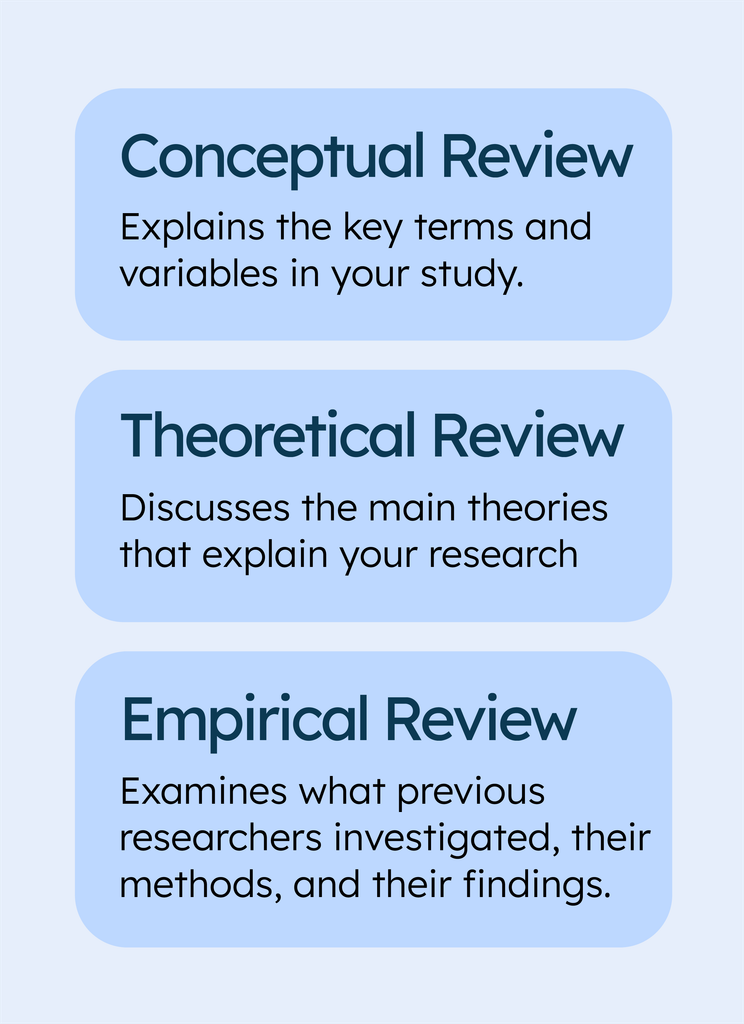
Although chapter formats differ across disciplines and institutions, a thesis literature review commonly contains three major areas.
A. Conceptual Review
This section explains the important concepts and variables in your study. For example, a study on social media marketing and purchasing behaviour might discuss:
- Meaning of social media marketing.
- Types or dimensions of social media marketing.
- Meaning of consumer purchasing behaviour.
- Relevant concepts such as brand engagement and purchase intention.
The aim is to establish a clear understanding of the key terms used in your research.
B. Theoretical Review
This section discusses the theories that help explain your research problem. For each relevant theory, consider its central assumptions, major propositions and how it relates to your study. Do not include theories simply to make the chapter longer. Choose theories that genuinely help explain the concepts or relationships you are investigating.
C. Empirical Review
This section examines previous studies related to your research, discuss what other researchers have investigated, the methods they used and what their findings reveal. You can organise this section around your research objectives, variables or major themes. The exact arrangement of these sections should follow your institution’s guidelines.
4. Create a Logical Chapter Outline
Once you understand the major areas of your review, arrange them into a chapter outline.
For example:
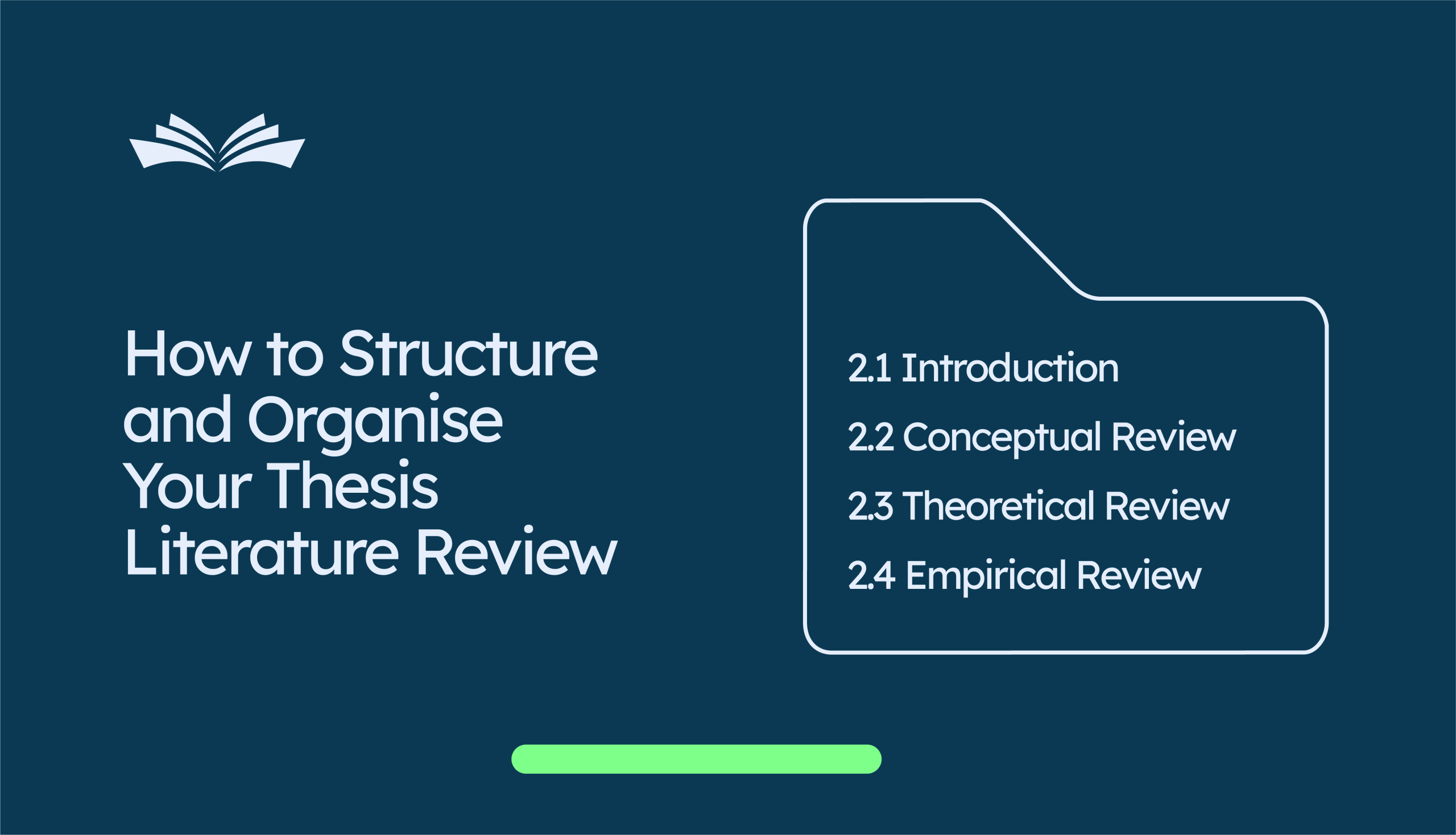
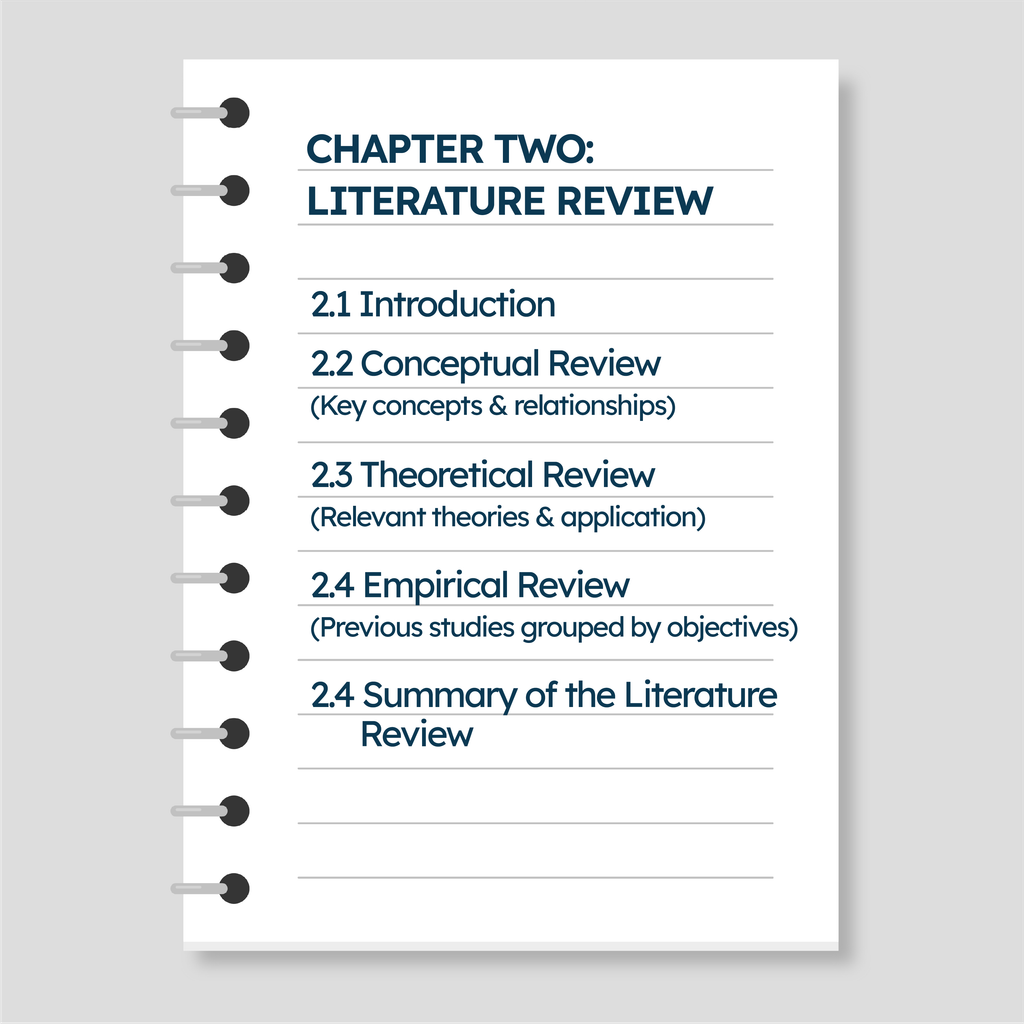
CHAPTER TWO: LITERATURE REVIEW
2.1 Introduction
2.2 Conceptual Review
- 2.2.1 Concept One
- 2.2.2 Concept Two
- 2.2.3 Relationship Between the Key Concepts
2.3 Theoretical Review
- 2.3.1 Relevant Theory
- 2.3.2 Application of the Theory to the Study
2.4 Empirical Review
- 2.4.1 Previous Studies Related to Objective One
- 2.4.2 Previous Studies Related to Objective Two
- 2.4.3 Previous Studies Related to Objective Three
2.5 Summary of the Literature Review
This is only a sample structure. Your department may require additional sections, a separate research gap discussion or a different arrangement. The important thing is to ensure that each section has a clear purpose and contributes to your research.
5. Prepare Before You Start Drafting
Before writing the full chapter, take a moment to check that you have:
- Identified the major concepts in your research.
- Gathered relevant academic sources.
- Organised your references.
- Grouped related literature into themes.
- Identified the theories relevant to your study.
- Created a chapter outline that follows your department’s requirements.
Having these things in place gives you a clearer starting point and reduces the need to repeatedly rearrange your work.
How Thesis SpeedWrite Can Support Your Literature Review Workflow
Organising references and planning how to work through your literature are important parts of developing a strong thesis, and Thesis SpeedWrite provides tools that support different stages of this process.
- Master Reference Library: Helps you manage and organise your research references.
- Literature Mapping: Helps you work through relevant literature and understand how existing research connects to your study.
- Writing Studio: Provides a space to work through your thesis sections as you develop your writing.
These tools support your research workflow, but you remain responsible for evaluating your sources, deciding what belongs in your review and developing your academic arguments.
Get a FREE THESIS REVIEW this week


Part of Thesis Speedwrite? You can now Earn while writing your Thesis
Conclusion
A well-organised literature review starts before you write the first paragraph.
Begin with your research objectives, organise your sources around relevant themes and create a chapter outline that gives your discussion direction. You do not need to write everything at once. Work through the sections systematically, making sure each one contributes to a clearer understanding of your research problem.
Working on your literature review?
Explore Thesis SpeedWrite and see how the Master Reference Library, Literature Mapping and Writing Studio can support your research process.