

You have chosen a thesis topic. You know the general area you want to explore, and you may already have a working title.
But when someone asks, “What exactly is your research about?” you find yourself explaining the subject rather than the problem you want to investigate.
This is a common challenge for researchers.
A topic tells your reader what your study is about. A research problem explains what needs to be investigated and why the study is worth conducting.
For example, “Social media and academic performance” is a broad topic. It identifies an area of interest, but it does not yet explain what the researcher wants to understand about it.
To develop a meaningful research project, you need to move beyond the subject itself and identify a specific issue, question or uncertainty that your study can address.
In this guide, we will explain what a research problem is, where to find one and how to develop it into a clear starting point for your thesis.
What Is a Research Problem?
A research problem is an issue, difficulty, unanswered question or gap in understanding that a study seeks to investigate.
It provides the reason for conducting the research.

A well-defined research problem helps you explain:
- What issue you want to investigate.
- What is currently known about it.
- What remains unclear or needs further investigation.
- Why the issue is worth studying.
Your research problem should give your thesis a clear direction. It should also help you determine what evidence you need, which research questions to ask and what objectives your study should pursue.
Without a clearly defined problem, it becomes difficult to decide what your research should focus on.
1. Start With Your Thesis Topic
Your thesis topic is a useful starting point for identifying a research problem.
However, a topic is usually broader than the specific issue you intend to investigate.
Consider this example:
Topic: Employee motivation in the workplace.
This topic identifies a subject area, but it does not tell us what the researcher wants to understand about employee motivation.
Are they interested in salary, recognition, job satisfaction, leadership or working conditions?
Each of these could lead to a different research problem.
To move beyond the topic, ask yourself:
- What do I want to understand about this subject?
- What issue have I noticed within this area?
- What questions does this topic raise?
- Why might this issue matter to the people or organisations involved?
The more clearly you can answer these questions, the easier it becomes to identify a specific research direction.
2. Read Existing Research to Understand What Is Already Known
One of the most useful ways to identify a research problem is to explore existing academic literature.
Research articles, review papers, theses and other scholarly sources can help you understand what researchers have already investigated and where further questions remain.
As you read, pay attention to the limitations of previous studies, recommendations for future research and findings that require further explanation.
You may discover that:
- A particular issue has received little attention in a specific context.
- Existing studies have reached conflicting conclusions.
- A problem has changed because of new circumstances.
- Researchers have identified limitations in the evidence or methods used.
- A question remains unanswered despite previous investigations.
These observations can help you identify a problem worth exploring.
However, not every research problem needs to come from a completely unexplored area. A study may also be valuable if it examines an existing issue in a different context, evaluates a proposed solution or investigates a new aspect of a familiar problem.
The important thing is to understand how your proposed research relates to what is already known.
3. Look for a Specific Issue, Not Just a Broad Concern
A broad concern can be a useful starting point, but you need to identify the particular issue your study will address.
For example, consider the topic:
Social media and academic performance among university students.
This topic could lead to several different research problems.
A researcher might be interested in whether students who spend more time on social media report different academic outcomes.
Another researcher might want to understand how students use social media while studying.
A third might be interested in students’ experiences of digital distraction during independent study.
Although these studies share a broad subject, they investigate different issues.
The challenge is to identify which problem you want to investigate and why it deserves attention.
A practical exercise: Complete this sentence:
“Although we know __________, we still need to understand __________.”
For example:
“Although students use social media regularly, we still need to understand how they experience social media distraction during independent study.”
This is not yet a complete research problem statement, but it helps you move from a broad subject to a more specific question.

4. Identify Why the Problem Matters
A research problem should not simply be an issue that interests you. You should also be able to explain why investigating it is worthwhile.
The significance of a problem may relate to its academic, practical or social importance.
For example, a study might help clarify conflicting findings in existing literature, provide a better understanding of a particular experience or generate evidence that could inform decisions in a specific setting.
The importance of a problem will depend on your discipline and the purpose of your research.
To assess its significance, ask:
- Who is affected by the issue?
- What might happen if the issue remains poorly understood?
- What could the research help clarify?
- How might the findings contribute to existing knowledge or practice?
You do not need to claim that your thesis will solve a major societal problem.
You need to explain what your study can realistically contribute and why that contribution is worth pursuing.
5. Make Sure the Problem Can Be Investigated
A research problem may be interesting and important but still difficult to investigate within the limits of your thesis.
Before committing to it, consider whether you can obtain the evidence needed to address the problem.
For example, you may identify an issue that requires access to confidential organisational records, a large group of participants or specialised equipment.
If those resources are unavailable, you may need to adjust the scope or investigate a related problem that is more feasible.
Consider the following:
- Is there enough relevant literature to support the study?
- Can you access the data or participants you need?
- Can you investigate the problem using an appropriate research method?
- Can you complete the study within your available time and resources?
- Does the proposed research meet your department’s requirements?
Feasibility does not mean choosing the easiest possible topic. It means identifying a research problem that you can investigate rigorously within your circumstances.
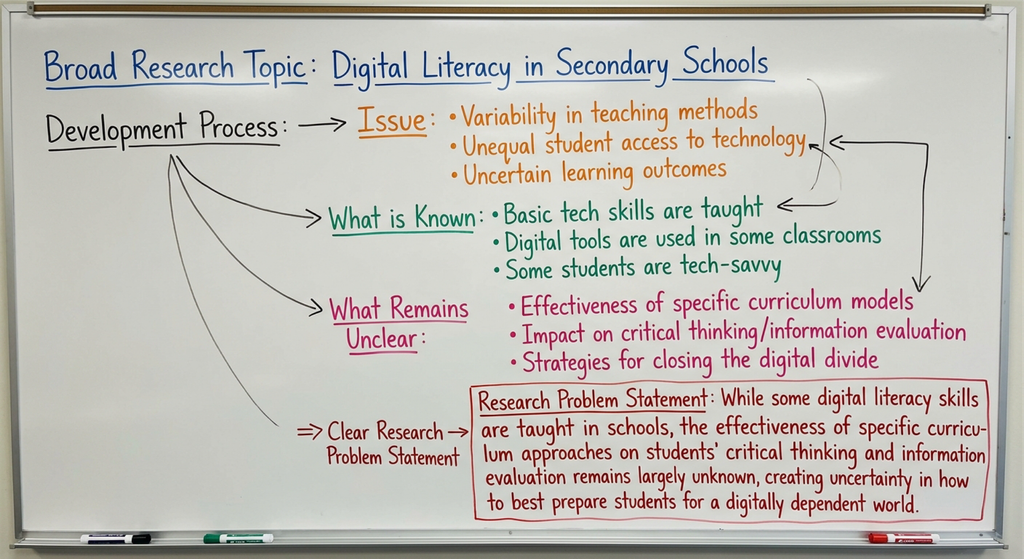
6. Turn the Research Problem Into a Clear Statement
Once you understand the issue, you can begin developing a research problem statement.
A useful problem statement generally introduces the issue, explains what is currently known and identifies what requires further investigation.
For example:
“Social media is widely used by university students, and its relationship with academic performance has received considerable research attention. However, students’ experiences of social media distraction during independent study may require further investigation in the context of a particular institution. This study therefore seeks to explore how undergraduate students experience social media distraction during independent study.”
This is an illustrative example. A real problem statement would need to be supported by relevant literature and evidence from the research context.
The purpose is to show how a broad topic can be developed into a more specific issue that gives the study a clear direction.
7. Check Whether Your Research Problem Is Clear
Before moving on to your research questions and objectives, review the problem you have identified.
Ask yourself:
Can I explain the problem clearly?
Someone reading your problem statement should understand what you want to investigate without needing to guess.
Is the problem supported by evidence?
Your explanation should be grounded in relevant literature, observations or other credible evidence.
Is there a reason to investigate it?
You should be able to explain why the issue matters within your academic or practical context.
Can I realistically investigate it?
The problem should be suitable for the available research methods, data and resources.
Does it align with my thesis topic?
Your research problem should develop naturally from the topic you have chosen.
If your answers reveal major uncertainties, return to the literature and refine your direction before proceeding.

What Comes After Identifying Your Research Problem?
Once you have a clear research problem, you can begin developing the research questions and objectives that will guide your study.
Your research questions should help you investigate the problem you have identified.
Your objectives should explain what you intend to accomplish in answering those questions.
These elements need to work together.
A clearly defined research problem gives you a stronger basis for developing the rest of your thesis, including the literature review and methodology.
If you are still deciding what to investigate, our guide on How to Choose a Thesis Topic: 7 Practical Tips for Getting It Right can help you identify a promising starting point.
Final Thoughts
Identifying a research problem is not simply about finding something that has never been studied before.
It is about understanding a subject well enough to recognise an issue worth investigating, explaining why that issue matters and determining how you can study it.
Start with your topic, explore existing research and look for a specific question or uncertainty that deserves further attention.
Then examine whether the problem is meaningful, researchable and appropriate for your thesis.
Once you can clearly explain what you want to investigate and why, you have a much stronger foundation for developing your research questions and objectives.
Ready to continue developing your research direction? Explore Thesis SpeedWrite to organise your research ideas and plan your next steps.