

You have chosen a thesis topic. You have an area you want to explore, and you may even have a working title ready for your proposal.
But something doesn’t feel quite right.
Perhaps your title sounds too broad. Maybe it resembles dozens of other studies you have seen. Or perhaps you understand the general subject you want to investigate, but you are struggling to express it as a clear, focused research topic.
This is a common stage in research. Having an idea is one thing; developing it into a topic that gives your study a clear direction is another.
The good news is that you don’t always need to abandon your original idea and start again. Often, the next step is to examine what you want to investigate, identify what needs to be more specific and explore stronger ways to frame the topic.
In this guide, we’ll explain what makes a thesis topic stronger, how to improve a basic title and how Thesis SpeedWrite’s Title Refinement feature can help you explore three possible directions for your research idea.
What Makes a Thesis Topic Basic or Too Broad?
A basic thesis topic is not necessarily a bad one. It may simply be an early idea that needs more development.
For example:
The Impact of Social Media on Students

This gives us a general subject, but it leaves several important questions unanswered.
Which students? What aspect of social media? What does “impact” mean in this context? What outcome or experience will the research examine?
The title could lead to several different studies, each requiring a different research question and approach.
Another example is:
Employee Motivation in the Workplace
This is a legitimate area of interest, but it is not yet clear what aspect of employee motivation the researcher wants to investigate.
The problem is not that these topics are necessarily unoriginal or unsuitable. It is that the research direction has not been sufficiently defined.
A stronger topic helps the reader understand what the study is about and gives the researcher a clearer basis for developing the research problem, objectives and methodology.
What Makes a Strong Research Topic?
There is no single formula for a perfect thesis title. Different disciplines have different conventions, and the right wording depends on the study.
However, a well-developed topic will generally have several important qualities.
1. It has a clear focus
The reader should be able to identify the main subject of the research without having to guess what the researcher means.
A topic that attempts to cover too many concepts, groups or issues can become difficult to investigate within the limits of a thesis.
Clarity helps you define what belongs in the study and what falls outside its scope.
2. It identifies a meaningful research direction
A strong topic points towards something the researcher intends to investigate, explain, compare, evaluate or understand.
It should do more than name a broad subject area.
For example, a topic about employee motivation could focus on the relationship between flexible working arrangements and job satisfaction, provided that this direction is supported by the research problem and an appropriate study design.
3. It is specific enough to guide the research
Depending on the discipline and project, this may involve defining a population, context, key variables, phenomenon or timeframe.
Specificity helps the researcher move from a general interest to a question that can be investigated.
However, adding more words does not automatically improve a title. Every detail should help clarify the study.
4. It has a credible academic direction
A topic should be capable of being developed into a coherent research project.
That means there should be a plausible connection between the title, research problem, objectives, questions and proposed methodology.
A polished title alone cannot establish that a study is feasible or academically sound. Those qualities require further examination of the literature, evidence, methods and research context.
How to Improve Your Thesis Topic
Before changing your title, take a moment to understand what you want your research to accomplish.
These steps can help you identify where refinement may be needed.
Step 1: Identify what you actually want to investigate
Start with your current topic and ask yourself what interests you most about it.
If your topic is about social media and academic performance, are you interested in time spent on social media, the use of particular platforms, students’ study habits or their experiences of distraction?
Each direction could lead to a different research project.
You don’t need to know every detail immediately. You do need to begin identifying the central issue you want to explore.
Step 2: Identify what is missing from the current title
Look at your working title critically.
Is the subject too broad? Are the main concepts unclear? Is the population undefined? Does the wording suggest a causal relationship that your proposed study may not be able to establish?
The purpose is not to make the title sound more complicated. It is to identify what needs clarification.
Step 3: Explore different ways to frame the same idea
One research interest can lead to several possible topics.
For example, an interest in social media and academic performance might lead to studies examining usage patterns, study habits or students’ experiences of digital distraction.
These are different research directions, not simply different ways of wording the same title.
Exploring alternatives helps you see which direction best fits your interests, available evidence and intended research approach.
Step 4: Check the direction against your research context
Before committing to a refined title, examine the relevant literature, consider what data you can access and determine whether the proposed scope is realistic.
You should also consider your department’s requirements and discuss your proposed direction with your supervisor.
A topic that sounds distinctive may still need substantial adjustment if the necessary evidence is unavailable or the research question cannot be addressed using a suitable method.
Refinement is an important step, but it is not a substitute for evaluating the study itself.
From a Basic Topic to Three Stronger Directions: An Example

Let’s use this initial idea:
Original topic: The Impact of Social Media on Students’ Academic Performance
The title is understandable, but it leaves the researcher with a wide range of possible directions.
Here are three illustrative ways the idea could be refined.
Option 1: Focus on a specific relationship
The Relationship Between Social Media Use and Academic Performance Among Final-Year Undergraduate Students at a Selected University
This direction defines a population and identifies a relationship to investigate.
It could suit a study designed to examine whether social media use and academic performance are associated. The researcher would still need to define how both concepts will be measured.
Option 2: Focus on study behaviour
Social Media Use and Study Habits Among Undergraduate Students: Exploring Patterns of Academic Engagement
This direction shifts attention towards students’ study habits and academic engagement.
It may be more appropriate for a researcher interested in how students use social media alongside their academic activities. The concepts would need to be clearly defined, and the final scope would need to match the proposed methodology.
Option 3: Focus on students’ experiences
Undergraduate Students’ Experiences of Social Media Distraction During Independent Study
This direction focuses on a particular experience rather than attempting to measure the overall impact of social media.
It could support a qualitative investigation into how students describe distraction, manage their attention and organise their study time.
Notice that the three suggestions are not simply longer versions of the original title. Each establishes a different direction for the research.
These examples are illustrative, not validated research topics. Before adopting any of them, a researcher would need to examine the literature, clarify the research problem and determine whether the proposed study is feasible.
That is the purpose of thoughtful topic refinement: to explore clearer possibilities before committing to one research direction.
How Thesis SpeedWrite Helps You Explore Better Topic Options
Sometimes, you understand the area you want to research but struggle to find the best way to frame it.
You might have written several versions of your title without feeling confident about any of them. Or you may want to explore alternative directions before deciding which one to develop further.
This is where Thesis SpeedWrite’s Title Refinement feature can help.
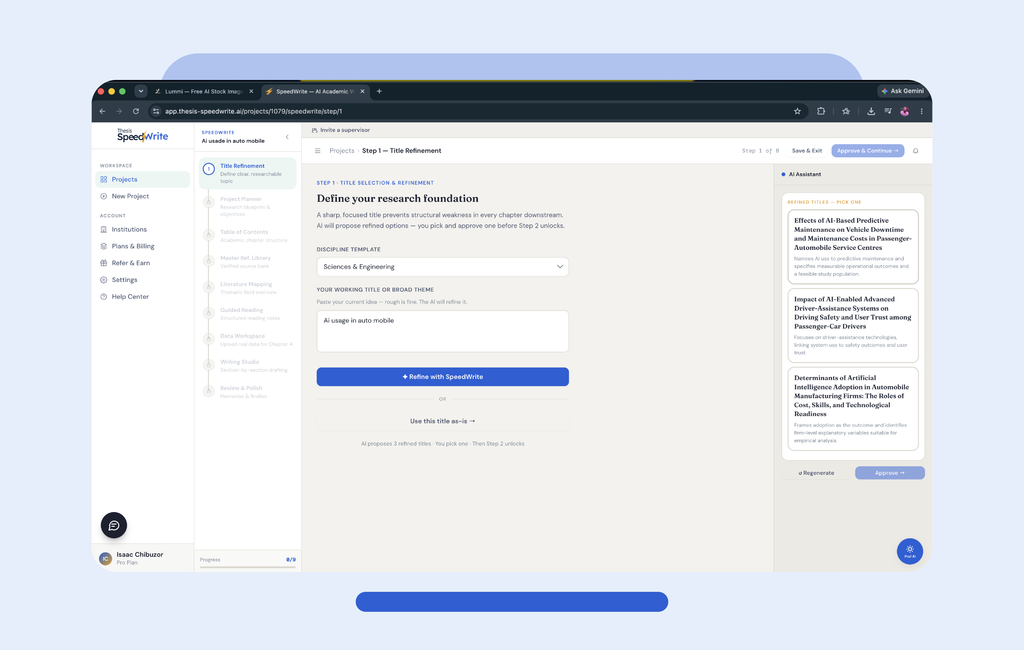
Rather than requiring you to begin with a completely new idea, the feature starts with the title you already have.
1. Start with your existing thesis title
Enter your current topic into the Title Refinement feature.
Your starting point might be a broad idea, a preliminary title or a topic you have been considering but have not yet finalised.
You don’t need to assume that your original idea is useless simply because it needs improvement.
2. Explore three refined topic suggestions
Thesis SpeedWrite works through your original title and provides three topic suggestions that offer alternative ways to develop your research idea.
This gives you options to consider instead of leaving you to generate every possible variation on your own.
The suggestions are designed to help you explore more focused, distinctive and academically appropriate ways of framing your research.
The value is not simply having three new titles. It is being able to compare different directions and decide which one best fits what you want to investigate.
3. Compare the suggestions against your research interests
Read each suggestion carefully.
Ask yourself:
- Which option best reflects the problem I want to investigate?
- Which direction is sufficiently focused for my project?
- Which option fits my academic discipline and research interests?
- Which option can I realistically investigate using available literature, data and appropriate methods?
You do not have to choose a suggestion just because it sounds impressive.
The best option is the one you can develop into a coherent research project and justify academically.
4. Continue developing the topic you choose
Once you have identified a promising direction, the work continues.
You still need to investigate the relevant literature, clarify the research problem, develop your objectives and questions, and consider an appropriate methodology.
You may also need to revise the title after discussing it with your supervisor or learning more about the subject.
Title Refinement helps you explore possible directions. Your academic judgement and further research help you determine which direction to pursue.
What to Do After Refining Your Thesis Topic
A stronger title is a useful starting point, but it is not the final test of a good research project.
Before committing to your selected topic, make sure you can explain the following:
The research problem: What issue, question or gap motivates the study?
The significance: Why is the problem worth investigating in your academic context?
The objectives: What specifically do you intend to accomplish?
The methodology: What approach could help you answer your research questions?
The feasibility: Can you access the relevant evidence and complete the work within your constraints?
These questions help you determine whether your chosen direction is ready to be developed further.
If you are still exploring possible ideas, return to our guide on How to Choose a Thesis Topic: 7 Practical Tips for Getting It Right. If you already have a working title, Title Refinement can help you explore alternative ways to frame it.
Final Thoughts
You do not have to get your thesis title perfect on the first attempt.
Your initial idea gives you something to work with. Reading, questioning, comparing alternatives and refining your direction can help you develop it into a more focused research topic.
The important thing is to move beyond choosing a title that simply sounds good. You need a research direction that you understand, can justify and can realistically investigate.
If you already have a thesis topic but want to explore better ways to frame it, Thesis SpeedWrite’s Title Refinement feature gives you three refined topic suggestions to consider.
Ready to explore your options? Try Thesis SpeedWrite and start with the research idea you already have.