
Key Takeaways
- Most late theses are late because nobody drew a map, not because the student wasn’t capable.
- Planning feels slow, but it saves you rewrites and surprises.
- Here is how to plan a thesis in 6 simple steps.
- Thesis SpeedWrite’s Project Planner turns that plan into something you can follow daily.
- A clear plan changes how your whole thesis feels.
We have seen it countless times. A student writes to us in week six, a little embarrassed. Chapter 1 is polished, Chapter 2 is half done, and their supervisor has just asked for a data collection timeline they don’t have.
They aren’t lazy. Most are working full-time, some are raising children, and all of them are trying. What they’re missing is a map, and nearly every one of them asks us the same thing:
how to plan a thesis when they can’t see what’s ahead.
So here’s what we tell them.
Why Theses Run Late
When we ask students why they’re behind, the answers are almost always the same.
They know the thesis has five chapters, but not what sits inside each one. They spend a month polishing Chapter 1 while data collection waits. Ethical approval takes three weeks, a supervisor takes two weeks to reply, and nobody counted either. Sections get written, deleted and written again because the structure was never clear. And when your thesis time is a few scattered hours between work and family, you spend half of each hour just deciding what to do.
Each of these costs a week or two. Together they can cost a whole semester.

Planning Saves Time (Even Though It Doesn’t Feel Like It)
We get it. You want to be writing, and thesis planning feels like stalling. Knowing how to plan a thesis is what turns scattered effort into steady progress.
But the hours you spend planning come back quickly. When you know what each chapter has to contain, you write it once. You open your work and know exactly what to do next. You spot the bottleneck in week two, when it’s easy to fix, and you walk into supervisor meetings with progress to show and specific questions to ask.
A big, vague project is frightening. A list of small, dated tasks is something you can start on today.
How to Plan a Thesis: 6 Steps
1. State your core research problem. In one or two sentences, name the gap or tension your study addresses.
2. Write your objectives and research questions. Three to five specific, measurable objectives, and the questions that match them.
3. Choose your research design and approach. Survey or interview, quantitative or qualitative, and why that fits your questions.
4. Define your population and sampling. Who you will study and how you will select them.
5. Pick your framework and set your scope. Name the theory guiding your study, and decide what is in and what is out.
6. Turn it into chapters and sections. Build a structure where every section exists because your blueprint needs it.

Once that’s done, set your own dates by working backward from your submission date, and leave room for supervisor feedback and final editing.
That is how to plan a thesis on paper, and you can do all of it in a document. The hard part is keeping every decision consistent with the others, and that’s where students tend to slip.
Project Planner and Table of Contents: Your Blueprint and Your Structure
This is why we built these two stages into Thesis SpeedWrite. They come right after you’ve refined your topic and title. (If your topic is still unclear, start with Title Refinement.)
They organize your work around the decisions you make. They don’t choose your methodology or write your content for you, because those judgement calls belong to you as the researcher. What they do is keep the whole project in view.
Together, they give you a thesis structure and a thesis table of contents built on your own research blueprint.
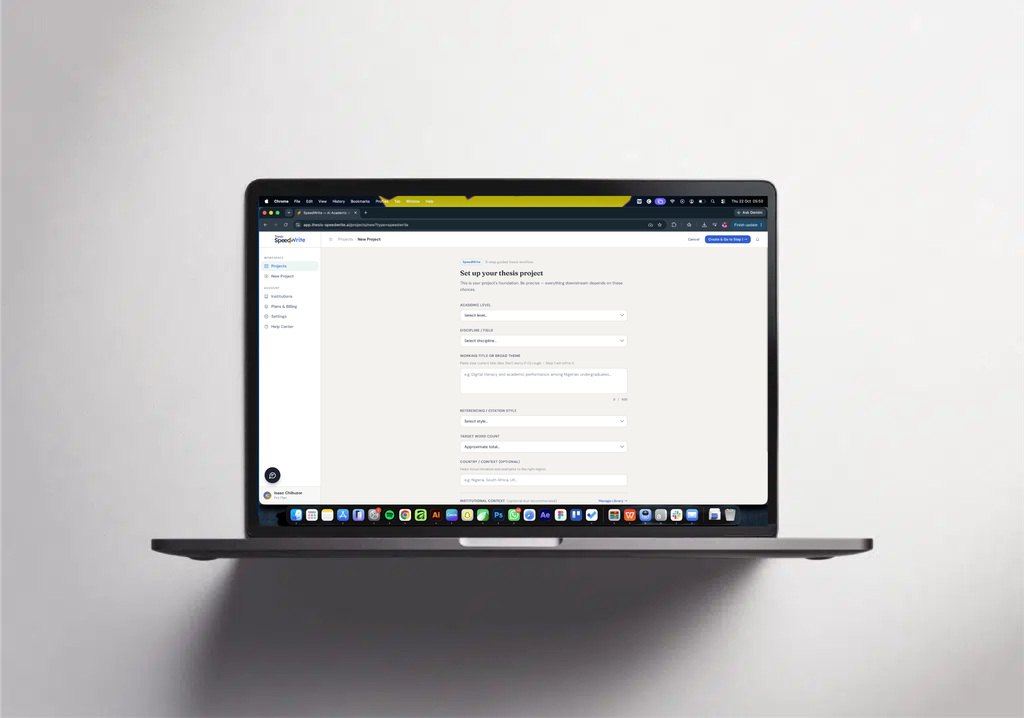
Start from your approved title. The Project Planner opens with the title you refined, so everything that follows stays connected to it.
Fill in your research blueprint. One page holds your core research problem, objectives, research questions, design, approach, population, sampling technique, theoretical framework, scope, significance and keywords. This becomes the control centre for every chapter, and nothing in your thesis should contradict it.
Let the AI Planner Assistant give you a first draft. If you’re not sure where to start, Auto-Fill drafts the fields from your approved title, level and discipline. You read it, change what doesn’t fit and confirm only what you agree with. The decisions stay yours.
Turn the blueprint into your chapters. In the Table of Contents stage, choose a structure that fits your study: Standard, Extended, Qualitative, Mixed Methods or Doctoral, or set your own number of chapters. Already have a template from your institution? Paste it in.
See your thesis as one map. Your chapters and sections appear in a single view, so you no longer carry the whole project in your head. Drag sections to reorder, click to edit, and add new ones where you need them. Every section should be defensible, so if it doesn’t serve your blueprint, it doesn’t stay.
Carry it forward. Once you lock your structure, it follows you into the later stages, from literature mapping to writing, so you always know where each piece belongs.
What Changes When You Have a Plan
Go back to our student in week six.
With a plan, they know exactly what’s left, and the hard chapters stop hiding. They open the planner each day, pick the next section and begin. Their next supervisor meeting is different too: they bring a timeline and ask for feedback on specific sections. When ethical clearance runs late, it moves one date instead of wrecking the semester. And they reach the final weeks with time to edit, because the work was spread out properly.
A plan doesn’t make the thesis easier. It makes the work visible, and work you can see is much easier to finish.blueprint

FAQ
How do I plan a thesis from start to finish?
List your chapters, break each into sections, and set deadlines working backward from your submission date. Schedule slow tasks like approvals and data collection early, add buffer time, and review weekly.
How long does it take to plan a thesis?
A solid plan takes a few hours to a couple of days. It saves weeks later by cutting rewrites and last-minute surprises.
What should a thesis project plan include?
Your chapters and sections, a deadline for each, dates for approvals and data collection, time for supervisor feedback, buffer time, and a slot for final editing.
Can I finish my thesis faster with a plan?
Yes. A plan reduces rework, saves you from deciding what to do every time you sit down, and shows delays early. If your time is limited, it helps even more.
Can AI plan my thesis for me?
AI can help you organize and structure your plan, but your methodology, scope and timeline are your decisions. Project Planner supports those decisions without making them for you.
What if I fall behind my plan?
Open it, see what’s left and move your dates. Talk to your supervisor early if your deadline is at risk. Adjusting early is better than abandoning the plan.
Ready to Build Yours?
If you’re still working out how to plan a thesis, you’re making it harder than it has to be, Thesis SpeedWrite’s Project Planner and Table of Contents guide you from a clear blueprint to a clear chapter structure, and every decision stays with you.
Start planning your thesis with Thesis SpeedWrite now.