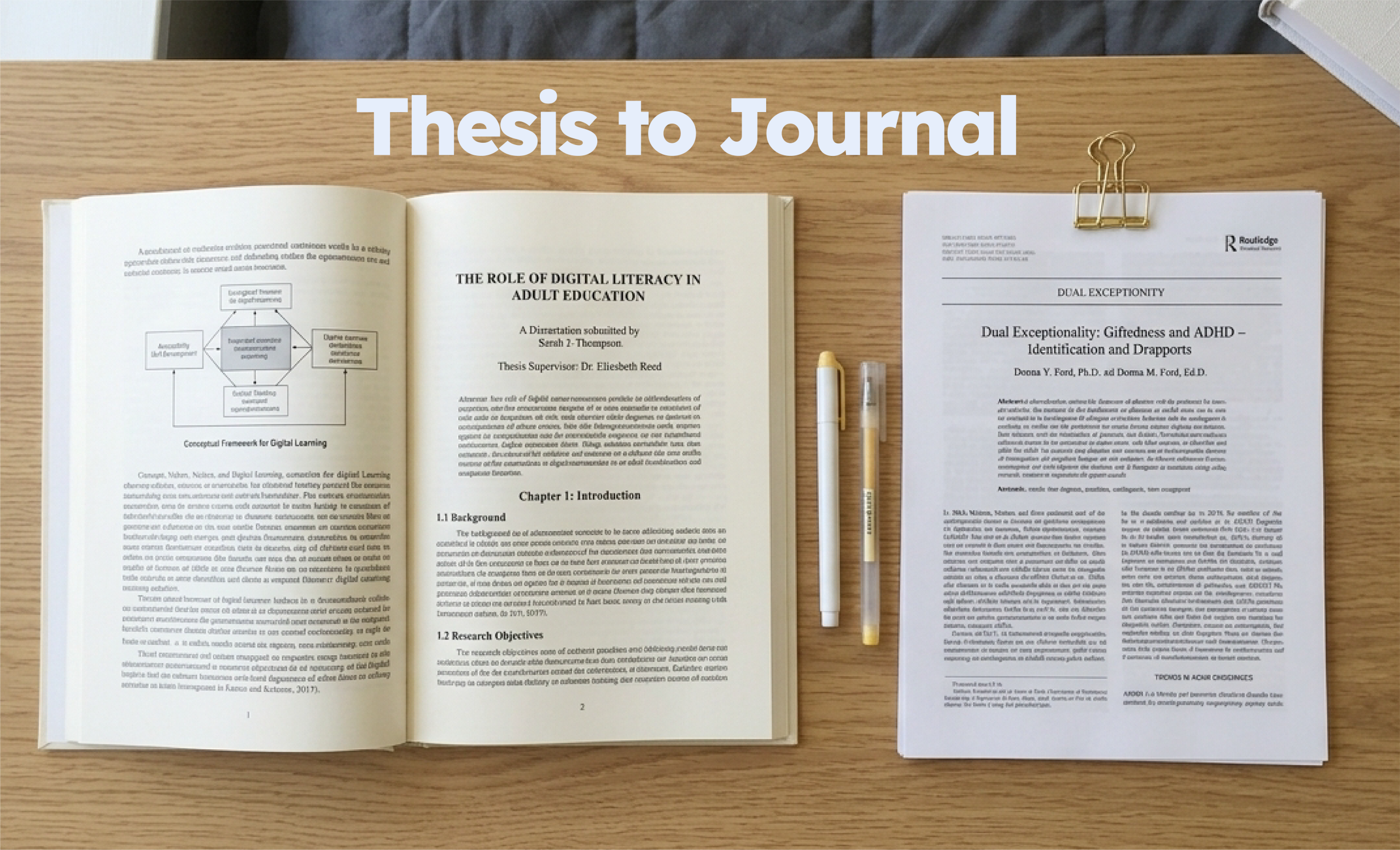
Quick answer: Pick one contribution from your thesis, choose your target journal before you write anything, cut everything that doesn’t serve that contribution, and rebuild the rest in the journal’s structure. Moving from thesis to journal article is a rewrite for a different reader, and most theses can produce more than one article.
You defended, or you’re about to, and your thesis will probably sit in a university repository where very few people will ever read it.
A journal article changes that.
It gets your work indexed, cited, and attached to your name, which matters for promotions, PhD applications, and credibility in your field.
Most people don’t struggle because they lack the findings. They struggle because they open the thesis, stare at 80,000 words, and have no idea where to start cutting. Here is the order that works.
Why a Thesis to Journal Article Conversion Isn’t Copy-Paste
Your examiners read to confirm that you did the work properly. Journal reviewers read to decide whether the work adds something new. Examiners expect length, and reviewers have a strict word limit and a pile of other submissions.
That is why pasting Chapter 4 into a template gets rejected. The material may be good, but it is arranged for the wrong reader. Everything below follows from that.
The 7 Steps From Thesis to Journal Article
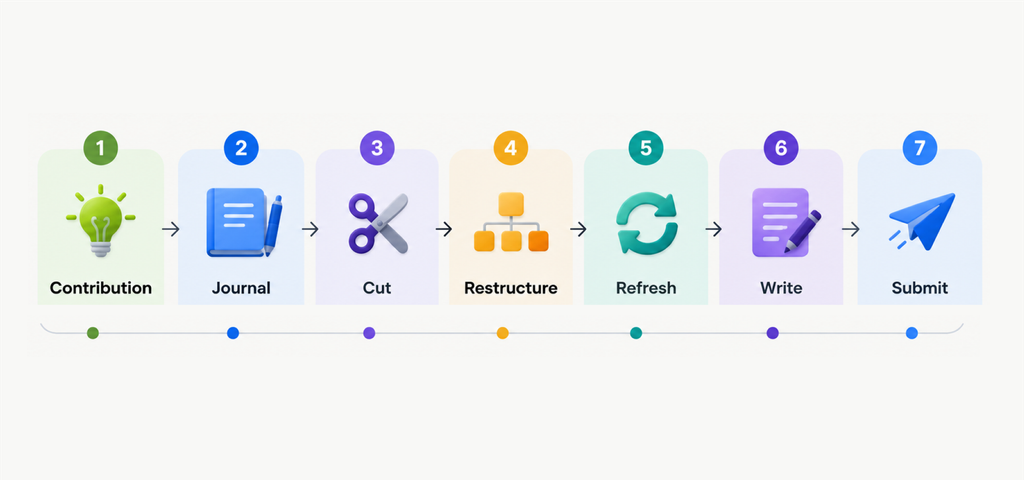
1. Decide what the article is about
One article, one question, one contribution. Write it in a single sentence: “This paper shows that ___, which matters because ___.”
If you can’t finish that sentence, you’re trying to publish the whole thesis, and that is how articles end up unfocused. A large thesis often holds two or three separate papers. List them, then start with the strongest.
Surprising results often make the best contribution. If your data went somewhere you didn’t plan, our post on when your thesis data doesn’t say what you expected covers how to work with that.
AI can help you brainstorm candidate articles by looking at your chapter summaries. It cannot decide which finding is your real contribution. That judgement comes from you, and your supervisor can sharpen it.
2. Choose the journal first
Don’t write the article and then look for a home. The journal decides the length, structure, citation style, and tone.
Check each candidate for:
- Aims and scope. Read the last few issues. If nothing like your topic appears, move on.
- Author guidelines. Note the word limit, section requirements, and reference style now.
- Indexing. Find out whether it appears in Scopus, Web of Science, or DOAJ, depending on what your institution or career path recognises.
- Fees and legitimacy. Be careful with journals that email you first, promise acceptance in days, or charge heavily with little editorial information. Verify the publisher before you submit anything.
Shortlist two or three journals so you have a fallback if the first one says no.
3. Cut hard
Journal articles are commonly a few thousand to under ten thousand words, so check your target’s limit. Your thesis is many times that. Here is where the words go:
- Literature review: shrink a full chapter to a few focused paragraphs. Keep only what sets up your gap.
- Methodology: keep what a reader needs to trust and replicate your work. Drop the long justification of paradigms.
- Results: keep the findings that support your one contribution. The rest can become a second article or stay in the thesis.
- Everything else: background chapters, extended tables, and appendices mostly go.
Cutting hurts. Remember that the full version still exists in your thesis, and nothing is lost.

4. Restructure for the journal
A thesis tells the story of what you did, in order. An article leads with what you found and why it matters.
Most empirical journals expect some version of Introduction, Literature, Methods, Results, Discussion, and Conclusion, but look at your target’s recent papers and copy their shape. Rewrite your introduction so the gap and your contribution are clear within the first page. A reviewer who can’t tell what’s new by then often stops reading with goodwill.
5. Refresh the literature
Your literature review may be one to three years old by the time you publish. Reviewers will notice if the newest source is from before your data collection. Search for recent work in your area, add what’s relevant, and check whether anyone has published something close to your contribution since you finished.
A tool that helps you map and organise sources saves real time here. What it surfaces still needs your reading and your decision about what matters.
6. Write the title and abstract last
The abstract is the most-read part of your article. Many reviewers form their first opinion from it. Write it after the body is settled, and state your question, method, main finding, and contribution in plain language.
Then write a title that someone could find by searching, and choose keywords that match how people in your field actually search.
7. Sort out authorship, permissions, and disclosure before submitting
These are the checks that cause delays if you skip them:
- Authorship. In many institutions, supervisors who shaped the work are listed as co-authors. Practices differ, so agree on this with your supervisor early.
- Prior publication. Most journals accept articles drawn from a thesis, but read the policy. Also check whether your university repository has an embargo option.
- Similarity. Your article will overlap heavily with your own thesis. Journals using similarity software expect you to state its origin, so say so in your cover letter.
- AI disclosure. Many journals now require you to declare how AI tools were used. Read the policy, and be honest about it.
- Ethics. Include your ethics approval details if your study involved participants.
Then write a short cover letter saying what the paper contributes and why it fits that journal, and submit.
What Happens After You Submit
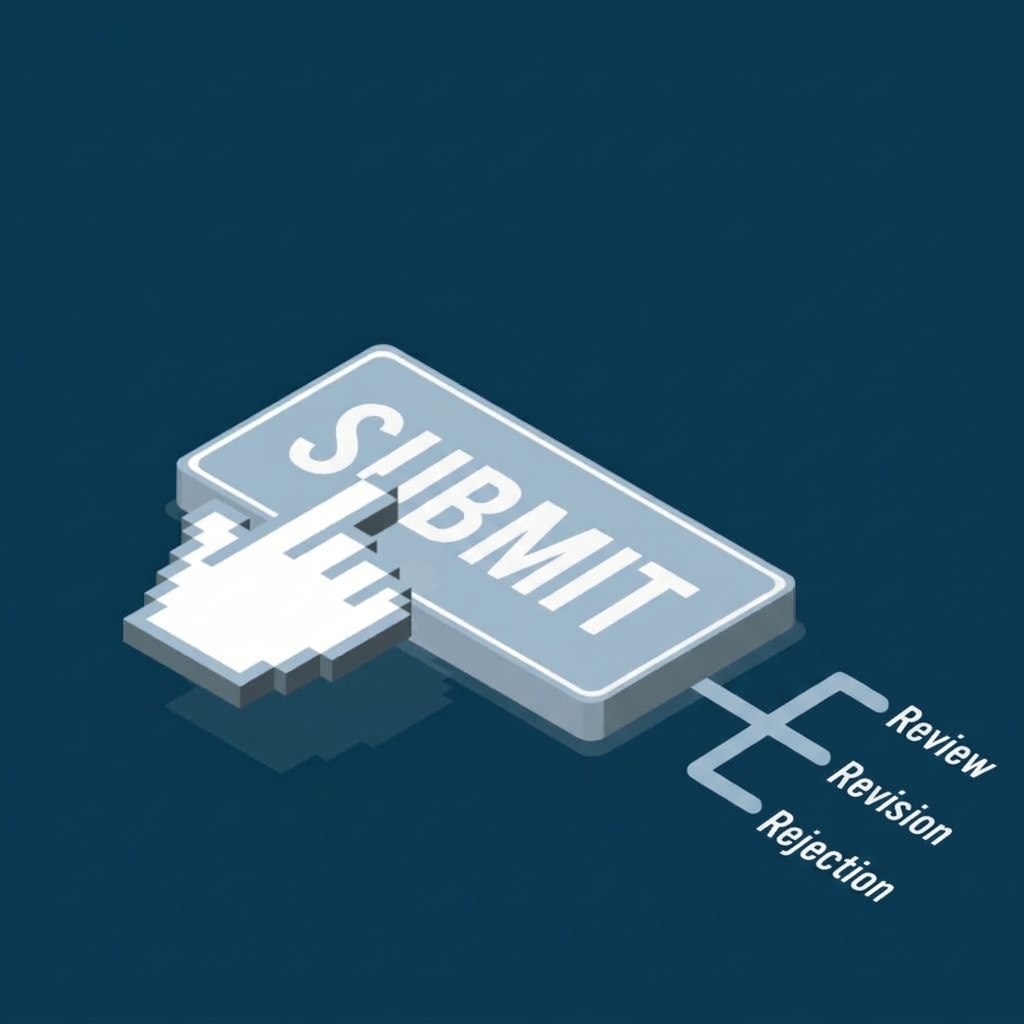
Expect a wait of weeks to months. The usual outcomes are reject, revise and resubmit, or accept with minor changes. A revise-and-resubmit is a good result. It means the editor sees potential. Answer every reviewer comment politely and specifically, even when you disagree with one.
A rejection is common and doesn’t mean the work is poor. Read the feedback, fix what’s fair, and send it to the next journal on your shortlist.
Where AI Fits, and Where It Doesn’t
AI can help you brainstorm which parts of your thesis could become separate papers, outline a restructured draft, and flag unclear sentences. Your contribution, your argument, and your interpretation of the data have to come from you. A reviewer is judging your thinking, and a journal will expect you to be able to defend every claim in the paper.
Get Guidance at Each Stage
Turning a thesis into a published article is much easier with a plan and someone who knows how journals work.
Thesisprofs Journal Hub supports you through publishing, from choosing the right journal to preparing your submission.
Editer gives your manuscript a professional edit before it goes out.
Thesis SpeedWrite helps you organise your sources and sharpen your thinking, and 1-on-1 coaching is there when you want a human who has published to talk it through with you.
Your thesis already holds the research. Publishing is how other people get to use it.