
You know your research topic. You have worked through your literature review, and you are beginning to understand the direction your study needs to take.
Now comes the part where you have to explain exactly how you intend to carry out the research. You open a blank document, type Chapter Three: Research Methodology, and then pause.
What comes next?
Should you start with the research design? How do you explain your population and sample? What information belongs under data collection? And how do you make sure all these sections connect?
The challenge is not always understanding what a methodology chapter is. Sometimes, it is knowing how to organise the information and turn your research decisions into a clear, well-developed chapter.
In this guide, we will walk through a practical Chapter 3 outline, explain what to prepare before writing each section, and show you how the different parts of your methodology chapter connect.
Note: Chapter 3 formats differ across universities, departments and research designs. Use your institution’s approved guidelines and your supervisor’s instructions when deciding which sections to include.
What Should You Do Before Writing Chapter 3?
Before you start writing paragraphs, take a moment to review the research decisions you have already made. Your methodology chapter should not be a collection of unrelated explanations. Each section should contribute to explaining how your study will answer its research questions.
For example, if your research investigates the relationship between students’ study habits and academic performance, you need to think about:
- What information do you need to answer the research questions?
- Who can provide that information?
- How will you obtain it?
- What instrument will you use?
- How will you analyse the information collected?
These questions help you establish the direction of your methodology before developing the full chapter.

Here are five things to review before you begin:
1. Your research problem: Be clear about the issue your study is investigating.
2. Your research questions: Identify exactly what your study intends to find out.
3. Your research objectives: Review what you intend to achieve through the study.
4. Your study population or data sources: Identify the people, documents, records or other sources relevant to your research.
5. Your departmental guidelines: Confirm the methodology format your institution expects.
Once these are clear, you can begin organising your chapter.
A Practical Chapter 3 Outline
A typical methodology chapter may follow this structure:
CHAPTER THREE: RESEARCH METHODOLOGY
3.1 Research Design
3.2 Area of the Study
3.3 Population of the Study
3.4 Sample Size
3.5 Sampling Technique
3.6 Research Instrument
3.7 Validity and Reliability of the Instrument
3.8 Method of Data Collection
3.9 Method of Data Analysis
3.10 Ethical Considerations
Not every research project will require all these headings. Some departments combine sections, use different terminology or require additional sections depending on the nature of the study.
The important thing is to understand what information belongs in each section and how to develop it.
What to Write Under Each Chapter 3 Section
1. Research Design
Start by explaining the overall design that will guide your research. Your research design provides the structure for investigating your research problem. It should reflect the type of information you need and the questions you intend to answer. Depending on your study, you may use a descriptive, correlational, experimental, case study, qualitative or mixed-methods design.
Before writing this section, prepare:
- The research design you intend to use.
- A clear explanation of what the design means.
- The reason you selected it.
- How it relates to your research questions and objectives.
A useful way to approach the writing:
First, introduce the selected research design. Next, explain its main characteristics. Finally, justify why it is suitable for your particular study. Avoid simply writing that you selected a descriptive research design because it is commonly used in your field. Explain why it fits what you are trying to investigate.
2. Area of the Study
This section introduces the location or context in which your research will take place. It may be a university, community, organisation, geographical area or another setting relevant to your investigation.
Before writing this section, prepare:
- The name and location of your study area.
- Relevant background information.
- Characteristics of the location that relate to your study.
- A reason the location is appropriate for the research, where necessary.
Keep the explanation focused. Include information that helps readers understand the setting of your research rather than adding unrelated historical details.
3. Population of the Study
Your study population refers to the entire group of people, objects or units that meet the criteria for your research. For example, if you are investigating the use of digital learning platforms among undergraduate students at a particular university, your population may consist of all eligible undergraduate students at that institution.
Before writing this section, prepare:
- A clear definition of your target population.
- The characteristics that qualify someone or something for inclusion.
- The geographical or institutional boundaries.
- The population size, if available and required.
- The source of the population information.
Your reader should understand exactly who or what your study concerns.
4. Sample Size
Your sample is the portion of the population selected to participate in or provide information for your study. The sample size is the number of participants, cases or units included. For example, if your eligible population consists of 2,000 students and you select 200 students, your sample size is 200.
Before writing this section, prepare:
- The sample size you intend to use.
- The method or formula used to determine it, where applicable.
- The assumptions behind the calculation.
- A justification for why the sample is appropriate.
Do not select a number without considering your research design, population, analysis requirements and available resources.
5. Sampling Technique
This section explains how you will select your sample from the population. Common probability sampling techniques include simple random, stratified, systematic and cluster sampling. Non-probability techniques include purposive, convenience, snowball and quota sampling.
Before writing this section, prepare:
- The sampling technique you intend to use.
- An explanation of how it works.
- The steps you will follow to select participants or units.
- Why it is appropriate for your research.
For example, if your study focuses on the experiences of students who have completed industrial training, purposive sampling may help you select participants with the relevant experience. Your sampling technique should be connected to the type of information your study needs.
6. Research Instrument
Your research instrument is the tool you will use to obtain the information required for your study. Examples include questionnaires, interview guides, observation checklists, tests and document review forms.
Before writing this section, prepare:
- The instrument you intend to use.
- Its main sections or components.
- The type of information it will collect.
- How it relates to your research questions and objectives.
- Whether it was developed for your study or adapted from an existing instrument.
For instance, if you are investigating students’ attitudes towards online learning, your questionnaire may contain questions about their experiences, opinions and access to digital learning platforms. Explain what the instrument is designed to collect rather than simply naming it.
7. Validity and Reliability of the Instrument
If your study uses a research instrument, you may need to explain how you will establish that it is appropriate and consistent. Validity concerns whether the instrument measures what it is intended to measure. Reliability concerns the consistency of the measurements it produces under appropriate conditions.
Before writing this section, prepare:
- The relevant validity procedure.
- The relevant reliability procedure.
- Details of any expert review or pilot testing.
- Any appropriate measurement or assessment technique.
For example, expert review may help establish whether questionnaire items adequately cover the concepts being investigated. A reliability measure such as Cronbach’s alpha may be appropriate for certain multi-item scales. The procedures you describe should fit your instrument and research approach. Qualitative studies may instead discuss trustworthiness through concepts such as credibility and dependability.
8. Method of Data Collection
This section explains how you will obtain the information needed for your study. Think of it as describing the actual process from the point of accessing your participants or data sources to obtaining the information.
Before writing this section, prepare:
- How you will access participants or data sources.
- How you will administer your instruments.
- How you will obtain informed consent, where applicable.
- How responses or observations will be recorded.
- Any permissions required.
If you are using questionnaires, explain how they will be distributed and retrieved. If you are conducting interviews, explain how participants will be contacted, how interviews will be arranged and how responses will be recorded. Your explanation should make the data collection process easy to understand.
9. Method of Data Analysis
After collecting your data, you need to explain how you intend to analyse it. The method of analysis should be determined by the research questions, objectives, research design and type of data. Quantitative studies may use descriptive statistics, correlation, regression, chi-square tests or other appropriate statistical methods. Qualitative studies may use thematic analysis, content analysis, narrative analysis or other relevant approaches.
Before writing this section, prepare:
- The type of data you expect to collect.
- The analysis techniques you intend to use.
- How each technique relates to your research questions.
- The software or tools you may use, where relevant.
A useful exercise is to create a simple table connecting your research questions to your analysis methods.
For example:
| Research question | Possible analysis approach |
|---|---|
| What are students’ study habits? | Frequencies, percentages or other descriptive statistics |
| Is there a relationship between study habits and academic performance? | An appropriate correlation analysis |
| How do students describe their learning experiences? | Thematic analysis of interview data |
These are illustrative examples. The actual analysis method must be selected based on your variables, data and research design.
10. Ethical Considerations
Where required, include a section explaining how you will protect participants and handle research data responsibly.
Before writing this section, prepare:
- Your informed consent process.
- How you will protect participants’ privacy.
- How confidentiality or anonymity will be maintained, where applicable.
- How data will be stored and protected.
- Relevant institutional ethical approvals.
Only include procedures that genuinely apply to your research.
How the Sections of Chapter 3 Connect

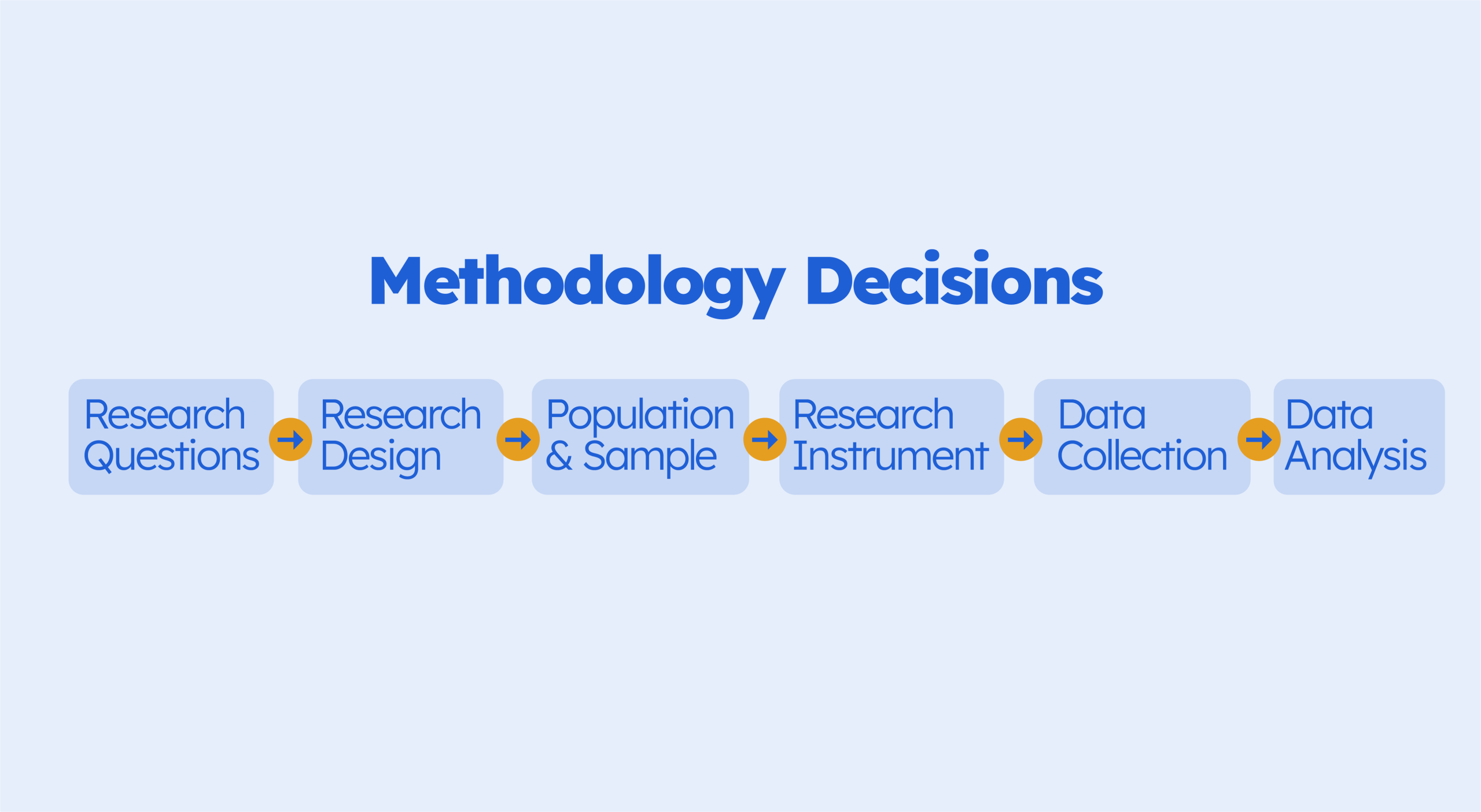
One of the most important things to understand when writing Chapter 3 is that the sections are connected. Your research design influences how you approach data collection. Your population informs your sampling decisions. Your research instrument determines the type of information you obtain, while your research questions help determine how that information should be analysed.
Consider this example:
A researcher wants to investigate the relationship between students’ study habits and academic performance. The research questions may focus on identifying students’ study habits and examining their relationship with academic performance.
The researcher then needs to:
- Select a design appropriate for investigating the relationship.
- Identify the population of students relevant to the study.
- Determine an appropriate sample and sampling technique.
- Select instruments or data sources for obtaining the required information.
- Explain how the data will be collected.
- Choose an analysis method that can address the research questions.
Notice how each decision contributes to the next. This is why it is important not to develop your methodology sections in isolation. A choice made in one section may affect the decisions you need to explain in another.
A Simple Checklist Before You Draft Chapter 3
Before turning your outline into full paragraphs, check whether you have the information needed for each section.
| Section | What you should have ready |
|---|---|
| Research design | Design, explanation and justification |
| Area of the study | Location and relevant context |
| Population | Target group and population information |
| Sample size | Number and justification |
| Sampling technique | Selection method and procedure |
| Research instrument | Instrument and what it measures |
| Validity and reliability | Relevant assessment procedures |
| Data collection | Collection process and permissions |
| Data analysis | Analysis methods linked to research questions |
| Ethical considerations | Relevant consent, privacy and approval procedures |
Use this checklist to identify gaps before writing. If you cannot explain why you selected a particular method or where your population information came from, you may need to do more preparation.
How Thesis SpeedWrite Helps You Work Through Your Methodology

Organising Chapter 3 becomes easier when you have a clear picture of your research project, the literature informing it and the decisions you need to make.
This is where Thesis SpeedWrite can support your workflow.
Rather than treating methodology as an isolated chapter, SpeedWrite helps you work through your research project from Step 2, giving you a more organised foundation as you develop your study.
You can also use the Master Reference Library to organise and work with your references, while Literature Mapping helps you work through relevant literature and understand how existing research connects to your study.
When you move into the Writing Studio, you can use that groundwork to work through your thesis sections, including your methodology.
The benefit is that you are not approaching the writing process with disconnected pieces of information. Your project planning, references and literature work can support the decisions and explanations you develop in your methodology.
SpeedWrite does not make your academic decisions for you. You still need to assess your research design, confirm that your methods fit your study and follow your institution’s requirements.
Explore Thesis SpeedWrite and organise your research process from planning through to writing.
Final Thoughts
Writing Chapter 3 becomes more manageable when you understand what each section requires and prepare the necessary information before drafting.
Start with your research questions and objectives. Establish the research design, identify your population and sampling approach, select appropriate instruments, and explain how you will collect and analyse your data.
Most importantly, make sure the decisions connect.
Your methodology chapter should tell a clear story about how you intend to investigate your research problem, why your chosen methods are appropriate and how the process will help you answer your research questions.
You do not have to figure out every paragraph at once. Work through the decisions, organise your information and develop each section carefully.